


Hi Friend 👋
I’ve invited a special guest to write today’s post. With more than 72,000 subscribers, Macro Notes is one of the largest macro publications on Substack. Earlier this year, I wrote a guest post for his readers, and now he’s returning the favor.
His thesis-driven approach to investing is almost as different from mine as it could be. But sometimes, the best way to learn something new is by studying those who do it differently, and Macro Notes is great at explaining how he thinks.
Opposite strategies can actually complement each other. Even for dedicated rules-based investors, this can open up opportunities for diversification alongside our core strategies.
The views in the article are of course Macro Notes’ own and not recommendations from MarketFighter. I hope you will enjoy reading his post as much as I did!
— MarketFighter
I’m Pierre, the founder of MacroNotes.com and the author of Macro Notes, an investment research newsletter now followed by more than 72,000 readers.
On Macro Notes, I write primarily about global macro investing.
If you’re not familiar with this approach, the idea is relatively simple.
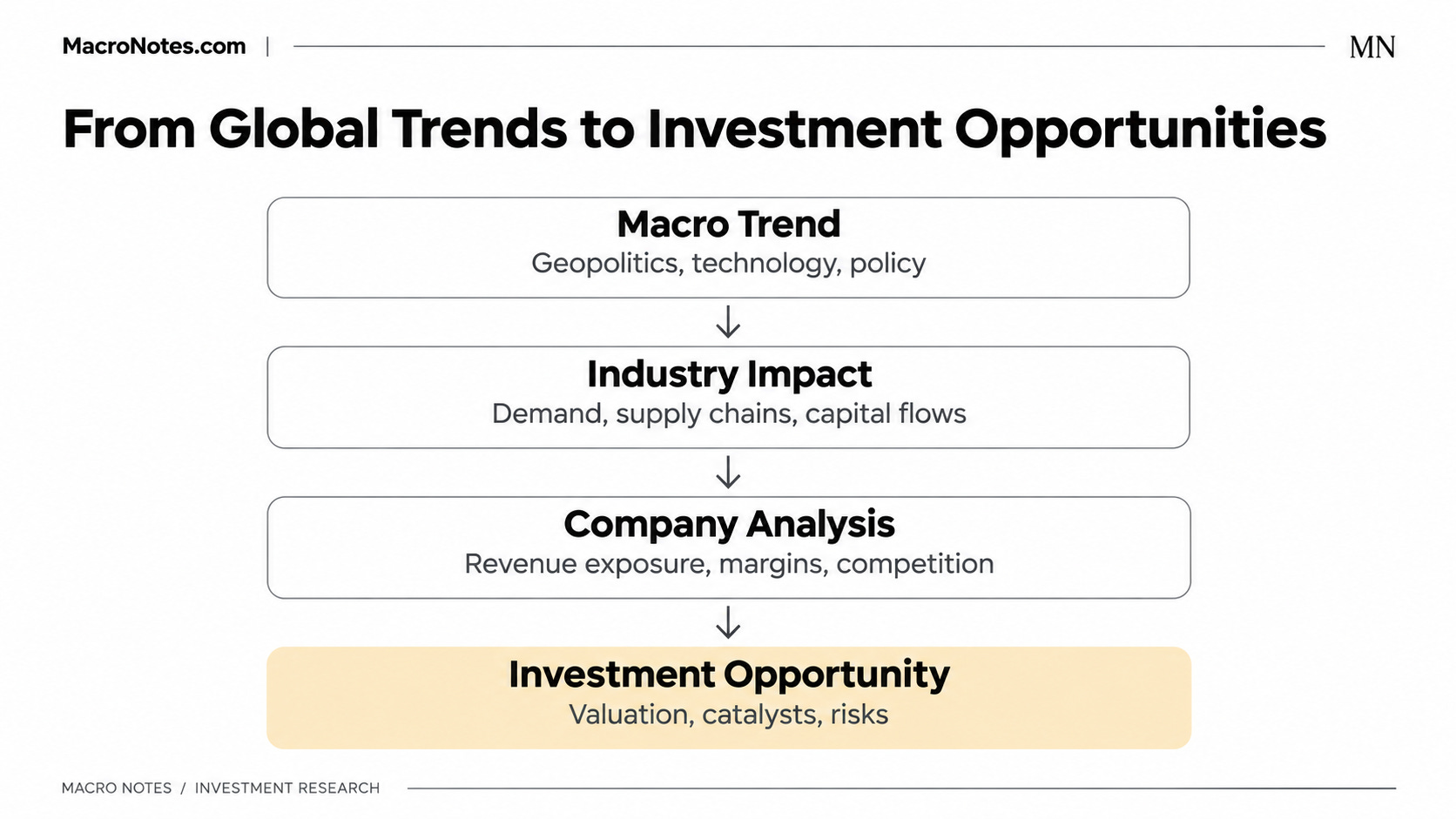
Rather than starting with an individual stock and trying to determine whether it’s a good investment, I generally start by looking at what’s happening in the global economy.
I look at technological developments, geopolitical changes, government policies, shifts in supply and demand, and the industries that could benefit from them.
From there, I work my way down to individual companies.
This is what we call a top-down investment approach. We start with the bigger picture, identify the industries that could benefit from a particular trend, and then analyze the companies best positioned to capture that opportunity.
Of course, identifying a promising industry doesn’t necessarily mean identifying a good investment. I’ll come back to that later.
But first, I want to explain how I started investing this way.
My First Macro Investment Thesis: Tesla
I started investing in Tesla more than ten years ago.
At the time, the macro trend I had identified was the transition from combustion-engine vehicles to electric vehicles.
Today, electric cars are everywhere. But back then, things looked very different.
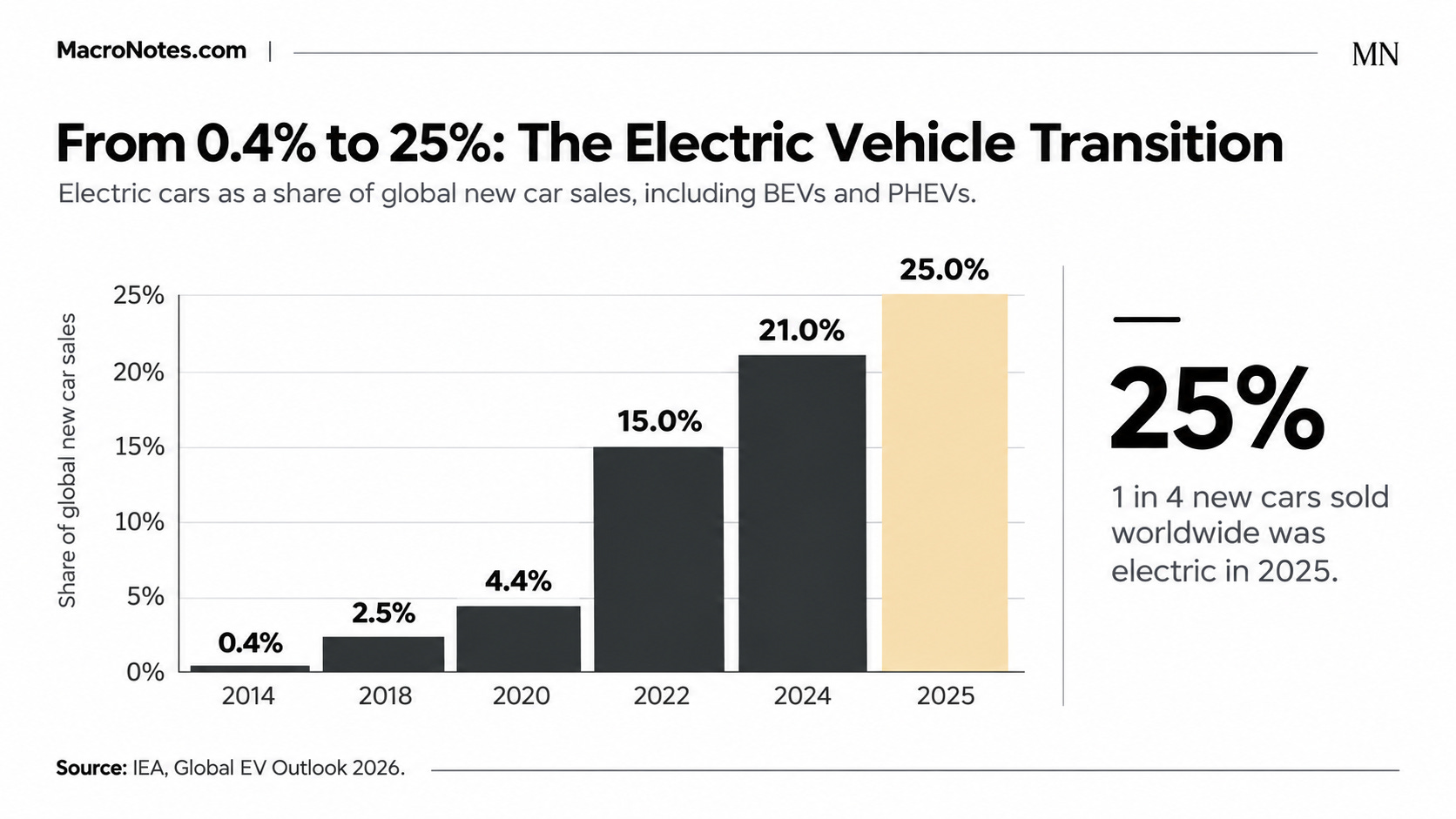
In 2014, electric vehicles accounted for only about 0.4% of global new car sales, according to historical data from the International Energy Agency.
My investment thesis was largely based on something that had little to do with Tesla’s financial statements.
I believed that the automotive industry was extremely sensitive to government policy, and that governments around the world were increasingly moving toward electrification.
We had already seen something similar happen with diesel vehicles.
For decades, diesel benefited from favorable taxation in several European countries. In France, for example, diesel fuel was taxed significantly less than gasoline, which helped encourage its widespread adoption.
My reasoning was that governments could play a similar role in accelerating the adoption of electric vehicles.
And the first signs were already there.
In France, the government introduced the bonus-malus écologique system in 2008, offering financial incentives for lower-emission vehicles while penalizing more polluting ones.
In China, the government launched programs supporting electric vehicles in public fleets in 2009. In 2010, it expanded support to private buyers in selected cities, with subsidies of up to RMB 60,000 for eligible battery-electric cars.
In the United States, federal tax incentives were introduced for qualifying plug-in electric vehicles, with credits of up to $7,500 available for many eligible passenger cars under the rules in place from 2010.
These policies were different, but they pointed in a similar direction.
Governments were increasingly using taxation, subsidies, and regulation to encourage the development and adoption of electric vehicles.
At the same time, the technology was becoming more competitive.
Tesla’s Model S already demonstrated that an electric car could offer driving range comparable to what many consumers expected from a conventional vehicle. The 85 kWh version offered an EPA-rated range of approximately 265 miles.
Battery technology was improving, concerns about CO₂ emissions were becoming more important, and the automotive industry was beginning to invest seriously in electrification.
My thesis was that if governments continued supporting the transition, and battery technology continued improving, electric vehicles could eventually capture a significant share of the global automotive market.
And because the automotive industry is enormous, even a relatively small change in market share could create opportunities for manufacturers and suppliers.
That’s also when I launched my first financial newsletter.
I started writing about my investments in Tesla, but also about other companies exposed to the transition, including manufacturers and suppliers involved in the emerging electric-vehicle ecosystem.
I wasn’t only interested in which car manufacturer would win.
I wanted to understand which businesses could benefit from an industry undergoing a major transformation.
More than a decade later, the overall thesis has largely played out.
According to the International Energy Agency, more than 20 million electric cars were sold worldwide in 2025, representing approximately 25% of all new car sales.
In China, electric vehicles accounted for nearly 55% of new car sales. Across Europe, the figure reached approximately 28%.
That’s a remarkable transformation for an industry in which electric vehicles represented less than 1% of global sales when I was developing my initial thesis.
My investments in this sector generated substantial returns.
But there’s something important I learned from that experience.
Being right about a macroeconomic trend doesn’t necessarily mean you’ll make money investing in it.
The Problem With Being Right About a Trend
This is probably one of the most important limitations of macro investing.
You can correctly identify an industry that will grow significantly over the next ten years and still lose money investing in it.
I’ve made mistakes applying this approach more than once.
Sometimes the problem isn’t the thesis itself. It’s how the thesis translates into a company’s financial performance, the price you pay, or the expectations already reflected in the stock.
Tesla is actually a good example.
Today, Tesla’s valuation isn’t simply determined by the number of electric vehicles it sells.
Investors have been pricing in expectations related to autonomous driving, robotaxis, artificial intelligence, robotics, and other potential businesses.
In other words, Tesla’s stock market valuation extends well beyond the original electric-vehicle thesis.
And that’s why I believe fundamental research alone isn’t enough.
You also need to understand what the market is already expecting, how a company’s valuation compares with its potential earnings, and what could cause investors to change their expectations.
A company can operate in an industry growing 30% annually and still be a terrible investment if its valuation already assumes even faster growth.
On the other hand, a less exciting company operating in a slower-growing industry can become an excellent investment if the market underestimates its future earnings.
That’s the distinction I try to make in my research.
I don’t simply want to identify industries that will grow.
I want to identify situations where the economic opportunity may be greater than what the market currently expects.
Applying the Same Approach to Other Industries
Over the years, I’ve continued applying this approach to different industries.
Today, Macro Notes covers investment theses ranging from artificial intelligence and energy infrastructure to space, defense, commodities, and emerging technologies.
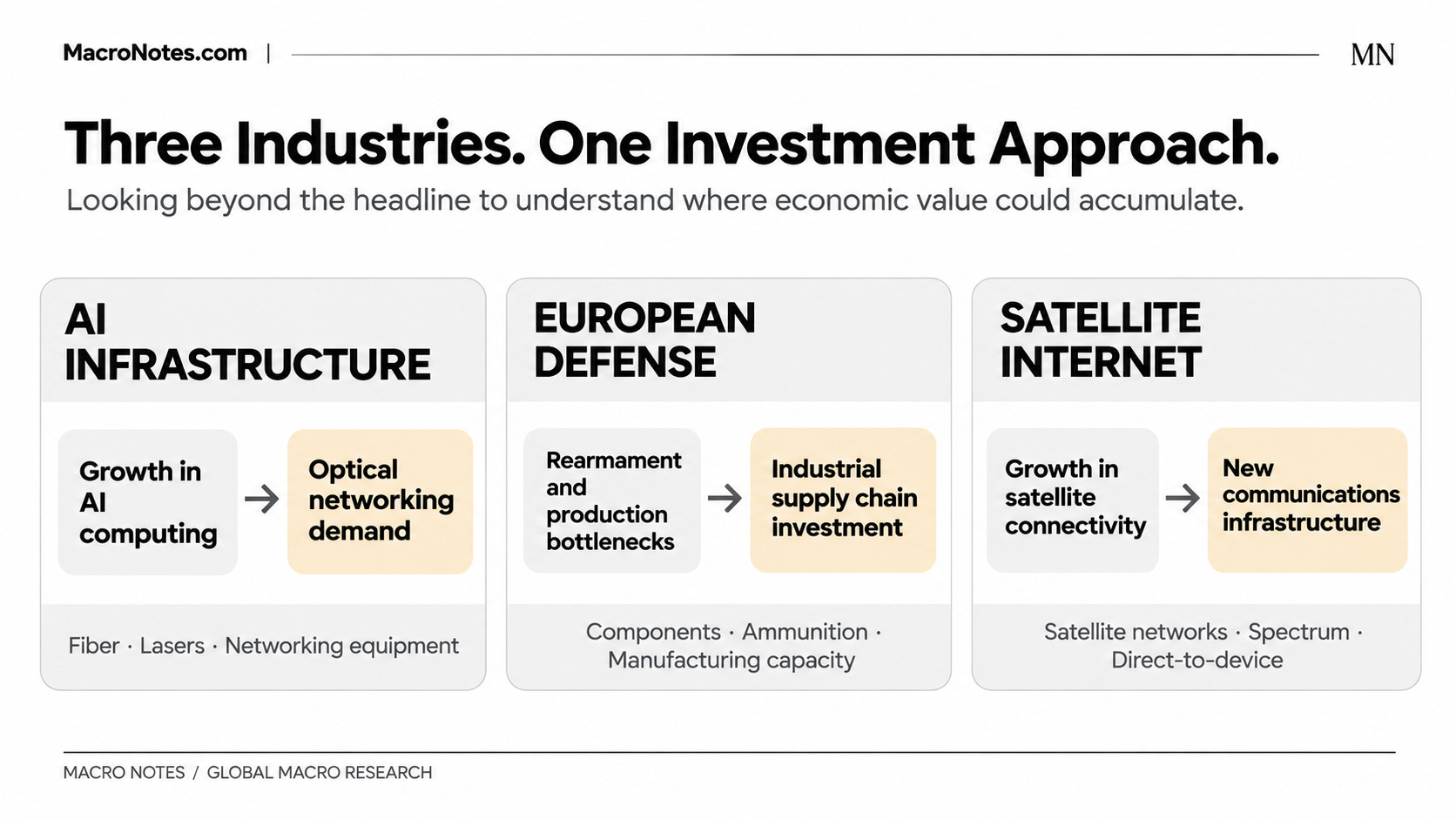
One example is our research on fiber optics.
The macro trend was the rapid expansion of AI computing infrastructure.
While most investors were concentrating on GPUs and semiconductor manufacturers, I became interested in something else: the networking infrastructure needed to connect increasingly powerful computing clusters.
As these clusters grow, moving data efficiently between processors becomes more demanding, creating opportunities for suppliers of optical fiber, lasers, and networking equipment.
That led us to research companies such as Corning, Ciena, and Lumentum.
I first began developing this thesis in March 2025 and have continued following the industry as demand, capacity constraints, and valuations have evolved.
Another example is European defense.
Following Russia’s invasion of Ukraine, European governments began accelerating military spending and rebuilding industrial capabilities.
Rather than looking only at the largest defense contractors, I became interested in the industrial supply chains supporting weapons production.
In October 2026, the European Commission announced €168.2 million in funding for projects expected to mobilize approximately €1.26 billion in industrial investment, aimed at expanding production of key components for missiles, drones, and ammunition.
We explored which suppliers might benefit from these bottlenecks and how additional production capacity could affect their earnings.
I’ve also followed the development of satellite internet for several years.
By June 2026, Starlink had reached approximately 12 million subscribers, demonstrating how quickly satellite broadband had developed into a commercial communications business.
But my interest wasn’t limited to SpaceX.
We also investigated publicly traded companies exposed to satellite connectivity, direct-to-device communications, and spectrum infrastructure.
These are three very different industries. Yet the research process is broadly the same.
Identify a structural change, understand how it could reshape an industry, and determine which businesses might benefit.
A More Recent Example: The Arctic
More recently, I’ve been researching another macroeconomic thesis that I find particularly interesting: the growing strategic importance of the Arctic.
It’s a subject I’ve been following for some time, particularly since Russia’s invasion of Ukraine.
The Arctic sits at the intersection of several geopolitical interests.
Russia wants to protect its military infrastructure and access to northern maritime routes. China is interested in the region’s natural resources and potential shipping opportunities.
Meanwhile, the United States, Canada, and European countries are increasingly concerned about protecting their infrastructure, territorial interests, and access to the North Atlantic.
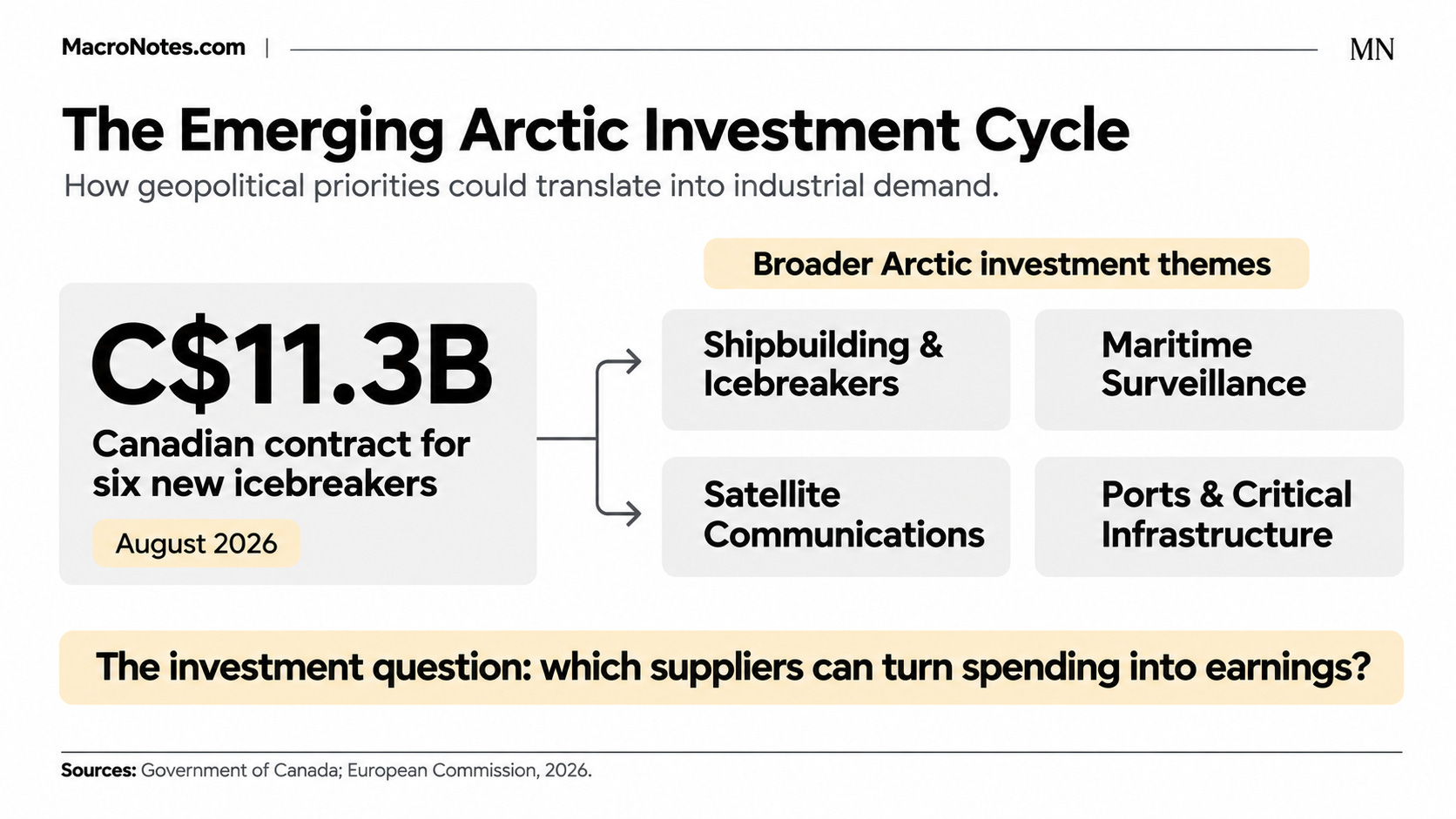
This creates growing demand for military capabilities, surveillance systems, specialized ships, ports, and communications infrastructure.
And recently, several developments made this trend particularly interesting from an investment perspective.
On August 24, 2026, Canada awarded a C$11.3 billion contract for six new icebreakers to replace aging vessels in its Coast Guard fleet.
These ships will support operations in several regions, including the Arctic during the summer navigation season.
Then, on October 20, the European Union presented an updated Arctic strategy.
The strategy includes plans to strengthen maritime surveillance, protect critical infrastructure, expand satellite monitoring, and explore ways to increase Europe’s icebreaker capacity.
Of course, announcing a strategy isn’t the same as awarding contracts.
But it gives us an indication of where governments are beginning to direct their attention and potentially their capital.
This is precisely the kind of development I look for.
The question becomes: where will the money actually go?
Who builds the icebreakers? Who supplies the specialized equipment? Which companies manufacture maritime surveillance systems? Who provides the satellite infrastructure needed to operate in remote northern regions?
And, more importantly, which of these opportunities could be significant enough to affect a publicly traded company’s earnings?
These are some of the questions I explored in a recent Macro Notes edition:
The New $50 Billion Arctic Spending Race
It’s still an emerging thesis, and there are many uncertainties.
Some government spending plans will be delayed. Some companies will struggle to translate new orders into profitable revenue. And some stocks may already reflect optimistic expectations.
But that’s also what makes this kind of research interesting to me.
By the time a trend becomes obvious and every investor is discussing the companies benefiting from it, a substantial part of the opportunity may already be reflected in their valuations.
What Happens After Identifying an Investment Thesis?
One thing I should clarify is that identifying a promising macroeconomic trend is only the beginning of the investment process.
An investment thesis can evolve over several years.
New competitors emerge. Governments change their policies. Supply chains adapt. Companies make acquisitions, increase production, or fail to deliver on their commitments.
And sometimes the initial thesis simply turns out to be wrong.
That’s why, at Macro Notes, we try to follow our investment theses rather than just publish an article and move on.
We’ve developed Macro Notes Terminal, where we track more than 100 thematic investment indexes associated with our research.
The objective is to document how each thesis evolves, what changes our assumptions, and when we believe an opportunity has become more or less attractive.
These indexes are research case studies rather than recommendations to copy. Different theses have different time horizons, methodologies, and risks.
I also think this is where fundamental macro research can complement a systematic approach to investing.
The way I would combine them is by giving each a clearly defined role.
A systematic strategy can remain the core of the portfolio, with its own allocation, entry, exit, and rebalancing rules. My macroeconomic views wouldn’t override those rules. If the system calls for reducing equity exposure, an exciting investment thesis wouldn’t be a reason to ignore that signal.
Alongside that core, an investor could dedicate a smaller, predefined allocation to opportunities identified through fundamental research. For illustration, that might mean keeping 90% in systematic strategies and reserving 10% for a separate research-driven allocation. The exact split would depend on the investor’s objectives and risk tolerance.
Within that smaller allocation, macro research would help determine what to investigate. Explicit investment rules would determine whether, when, and how much to invest.
Take the Arctic thesis I described earlier.
Government spending announcements would put certain suppliers on my research list. Before investing, I would want to see evidence that spending was translating into funded contracts, that those contracts could materially affect earnings, and that the valuation left room for a reasonable return.
An investor could then apply predefined position limits, liquidity requirements, and entry and exit criteria. A compelling narrative would earn a company further research, rather than an automatic place in the portfolio.
The two allocations would also need to be assessed together. If the systematic core already held substantial exposure to the same companies or sectors, adding a thematic position could increase concentration rather than provide diversification.
Finally, I would define what would invalidate the thesis: contracts being canceled, spending repeatedly postponed, or suppliers failing to earn the margins the investment case required.
That creates a practical division of responsibilities. Macro research generates and evaluates potential opportunities. Portfolio rules constrain how much capital is exposed to them, and the systematic core continues operating according to its own process.
It doesn’t eliminate forecasting risk. It gives that risk a defined place and a limited budget within the overall portfolio.
A Little More About Macro Notes
That’s essentially what I do at Macro Notes.
I publish research on structural changes taking place across the global economy, with a particular focus on identifying investment opportunities in publicly traded companies.
Our free editions introduce the macroeconomic trends and investment theses we’re investigating.
For Premium subscribers, we go further into the research, including company-level analysis, valuations, investment scenarios, risks, and ongoing updates as those theses evolve.
Premium subscribers also receive access to Macro Notes Terminal, where they can explore our investment indexes and follow the research behind them.
If this approach interests you, I’d encourage you to explore some of our research before deciding whether Macro Notes is worth following.
You can find my work at MacroNotes.com or subscribe directly to the Macro Notes newsletter.
Thanks for reading,
Pierre
Founder, Macro Notes

Disclaimer: The MarketFighter Strategy is for educational and informational purposes only. It is not financial advice, and the author is not a licensed investment advisor. Investing in ETFs involves significant risk, and past performance is never a guarantee of future results. You are solely responsible for your own trades and financial outcomes. Read the full Disclaimer here.
Loved your explanation of macro trends. Keep crushing it!
Bravo Pierre!