


Hi Friend 👋
Today, we’re trying out something new. I asked my friend Investor Denis from Stay Invested to write a guest post on this publication for us.
Denis is a highly skilled and successful ETF investor from Germany with a large following on Substack. His approach is different from mine, but we share the same beliefs in discipline, long-term thinking, and not trying to predict the market.
I hope you will enjoy this piece. If you like it, you can get a lot more by subscribing to his publication. Handing over to you now, Denis.
Best,
MarketFighter

It was in the evening in late 2019 that I was standing in my boss’s dark office when he said
“I will have to let you go.”
I’ve worked in research my entire life, and the problem here is there are too few permanent contracts. As per German law, you’ll have to leave after 6 years tops unless you’re not only bright but also hard-working and lucky.
And although my layoff never materialized (I was actually lucky), I told myself I never again wanted to be in a situation where I worried about money.
Because I loved my job and happily spent 12 hours a day in the laboratory, starting a side hustle to make more money wasn’t on my mind. I decided to dabble in investing instead.
Invest your money.
Let it grow.
Wait long enough.
Become work-optional.
Easy.
But where do you begin? In the US alone, there are over 4,000 public companies. There are 17,000 ETFs globally. You don’t know how to read a balance sheet or an income statement. You don’t even know what an ETF is.
And most importantly, how do you overcome the fear of investing if your uncle once invested his money and lost it all?
I thought investing was a scam but decided to give it a try anyway, as I didn’t know any other options. And made 3 mistakes immediately. They were rookie mistakes, but they shaped the investment strategy I adopted a few years later.
Mistake one: I went to my bank to get consulted on investing.
Asking the guy who had earlier onboarded me as a client seemed like a logical move. We went to an isolated room on the 3rd floor where he used a 20-minute questionnaire to determine my risk tolerance.
He ended up selling me a mutual fund managed by the bank for a 5% entry fee. My 10,000 EUR instantly became 9,500 EUR. It took me more than a year to break even. And because we had a Covid crash in 2020, I had to live with a temporary paper loss of 30%.
Never buy investment products from your bank.
Mistake two: I dumped a stock too soon.
My first stock was Coca-Cola. I bought 100 shares in November 2019 and received my first dividends ($20) a month later. I was euphoric. That payout felt like free money. I’d finally cracked the code.
Problems began when Covid became a global health crisis 3 months later. Coca-Cola isn’t a tech company, and its stock wasn’t among the first to recover. While I was collecting my quarterly dividends, the stock was still down. I was sitting on a paper loss and asking myself why I hadn’t bought Zoom or Amazon.
When I was close to breakeven in 2021, I sold Coca-Cola. Since then, the stock is up 55%. I can’t help but compare myself with Warren Buffett, given that he’s held Coca-Cola since 1988.
I was a beginner who expected quick gains. He’s an experienced investor who buys great companies at good prices and holds them forever. Lesson learned.
Don’t sell exceptional companies too early.
Mistake three: I got burned chasing dividend yield.
The next stock I bought was AT&T with a juicy 7% dividend yield. There was just one small problem I overlooked because I hadn’t really analyzed the company: It had an astronomical debt of $150 billion, roughly the size of Israel’s debt at the time.
The reason for the debt was an earlier acquisition of WarnerMedia, and AT&T didn’t manage to monetize that media empire. Eventually, it spun off WarnerMedia in April 2022 to merge it with Discovery Inc. and form Warner Bros. Discovery.
That’s when AT&T’s financial position improved. But in the process, the dividend was cut in half, and the stock also lost a significant chunk of its valuation.
A high dividend yield isn’t free money, it’s a warning.
A single line from an ex-banker showed me what investing should be like
For the next 2-3 years, I stopped chasing dividend stocks altogether and focused on growth stocks. My success rate wasn’t high. I made money more often than I lost it, but my gains of several thousand euros a year didn’t really move me closer to financial freedom.
A breakthrough came when I met (online) an ex-banker from the UK named David. You could easily tell he was a pro just by the words he was choosing to write articles on investing on Medium dot com.
When David got my attention, I started asking questions.
What’s the right portfolio allocation?
Which public companies will profit from AI?
Has he ever traded stocks?
David must’ve seen where I was going and told me to stop chasing get-rich-quick schemes. I kinda sorta knew that because my strategy wasn’t working. And then David said how he was investing:
“I reached financial freedom in 2002 solely by investing in dividend stocks and reinvesting my dividends.”
I wasn’t expecting this from an ex-banker. It’s boring, it’s not fancy, but this is why it works.
When someone drops the bombshell, you’re paralyzed. It took me several months to come to terms with David’s investment strategy. When I accepted the fact that dividends are the path to financial freedom, I took another month to find the dividend ETFs I’d be comfortable holding for longer than a decade.
I minimized the work it takes to manage my portfolio
I’ll tell you exactly why I went for ETFs instead of individual stocks.
My experience with Coca-Cola, AT&T, and a few other stocks I held before shows you always need to
time your entry and exit points
be on top of things to avoid catastrophic losses
be able to read between the lines to get what management tries to say at public events
Portfolio management is work. But if you still get half of your stocks wrong anyway, that’s not building wealth, that’s wasting your time.
And while I still want to be able to pick big winning stocks, I intentionally reduced my exposure to them and made dividend ETFs the foundation.
This is how my portfolio is structured as of September 2026:
Individual stocks: 12%
Dividend ETFs: 55%
Bitcoin: 33%
There are 50 to 2,000 individual companies in my dividend ETFs. Even if a couple of those companies go bust, my total payout will hardly be affected. That also limits dividend growth, but I’m OK exchanging it for peace of mind.
Stocks are volatile. My logic here is simple: If I’m right on my stocks, I’ll sell them for profit, pay capital gains tax (26,375% in Germany), and reinvest the profits into my dividend ETFs. If I’m wrong, the losses won’t wipe me out.
(I’m also a Bitcoin bull and I’m OK holding it through bear markets, the last of which just ended.)
Portfolio stability is important for building wealth long-term, and stability comes from dividend ETFs. It’s fine if my portfolio stays roughly the same for several months while I keep adding to the dividend ETFs. But it shouldn’t drop by, say, 50% unless a full-blown financial crisis hits.
My core argument for portfolio stability is this:
Dividend payers tend to have moats
Dividends are paid from free cash flow
Companies with strong cash flows are less volatile when the market is stressed
Overseas markets pose an additional risk
I need to clarify why I chose dividend ETFs over index-fund ETFs.
My goal is financial freedom, which means being able to do whatever I want with my time. Freedom doesn’t necessarily come from a large portfolio. For example, your house could be worth $1 million. But because it’s an illiquid asset that also happens to require regular maintenance, living in such a house doesn’t make you free.
What matters is not portfolio size, it’s cash flow. It’s how much money arrives in your account every month, no matter what you’re doing. I want to grow my dividend payouts to my monthly salary and beyond.
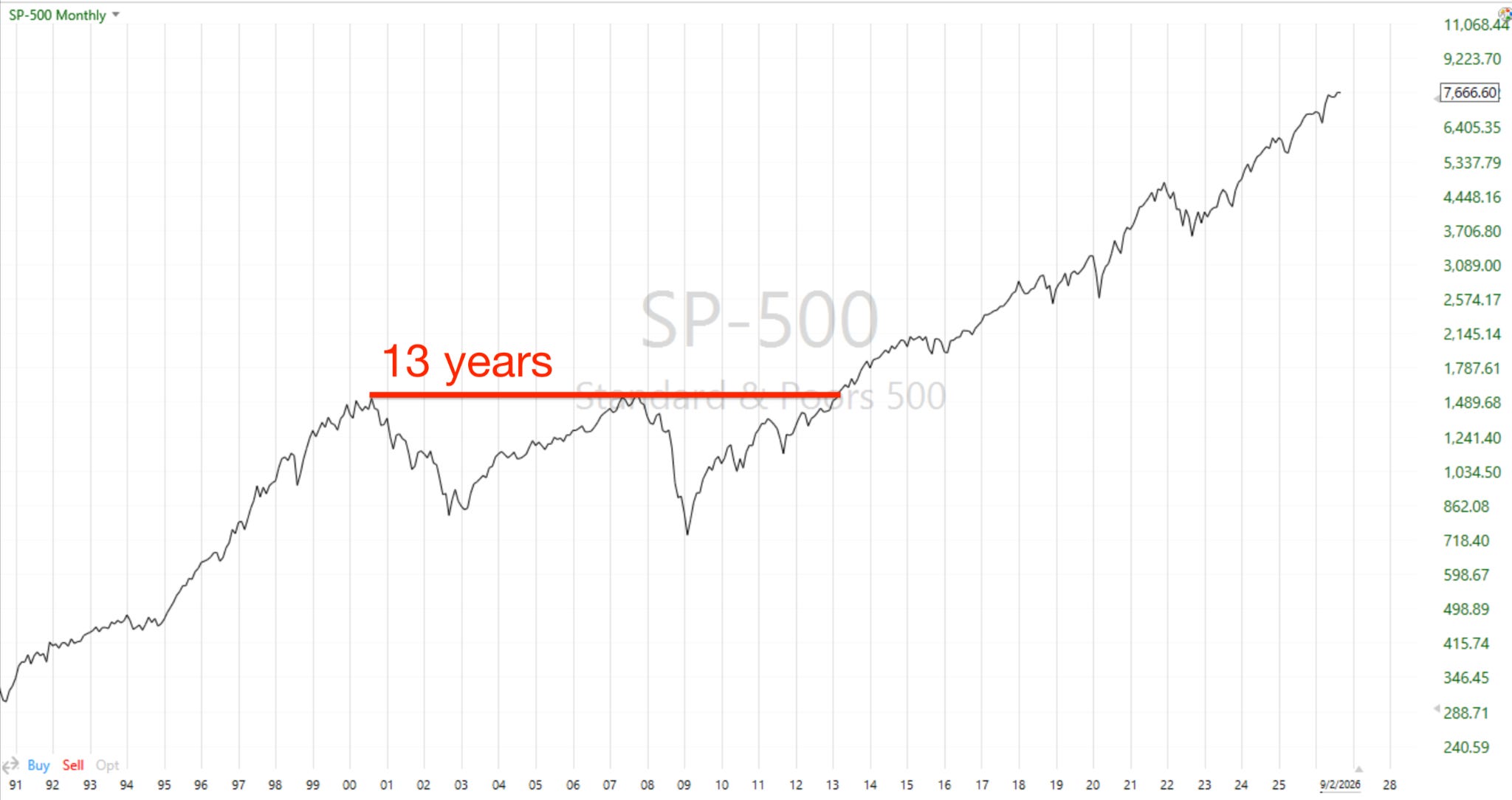
Owning an index fund means having to sell it once you’re retired or work-optional. Selling it means trying to time your exit points, which may or may not work out. And in the worst, highly unlikely, but plausible scenario, you may have to postpone your retirement by years, if not a decade. It took the S&P 500 13 years to break out above the 2000 high again.
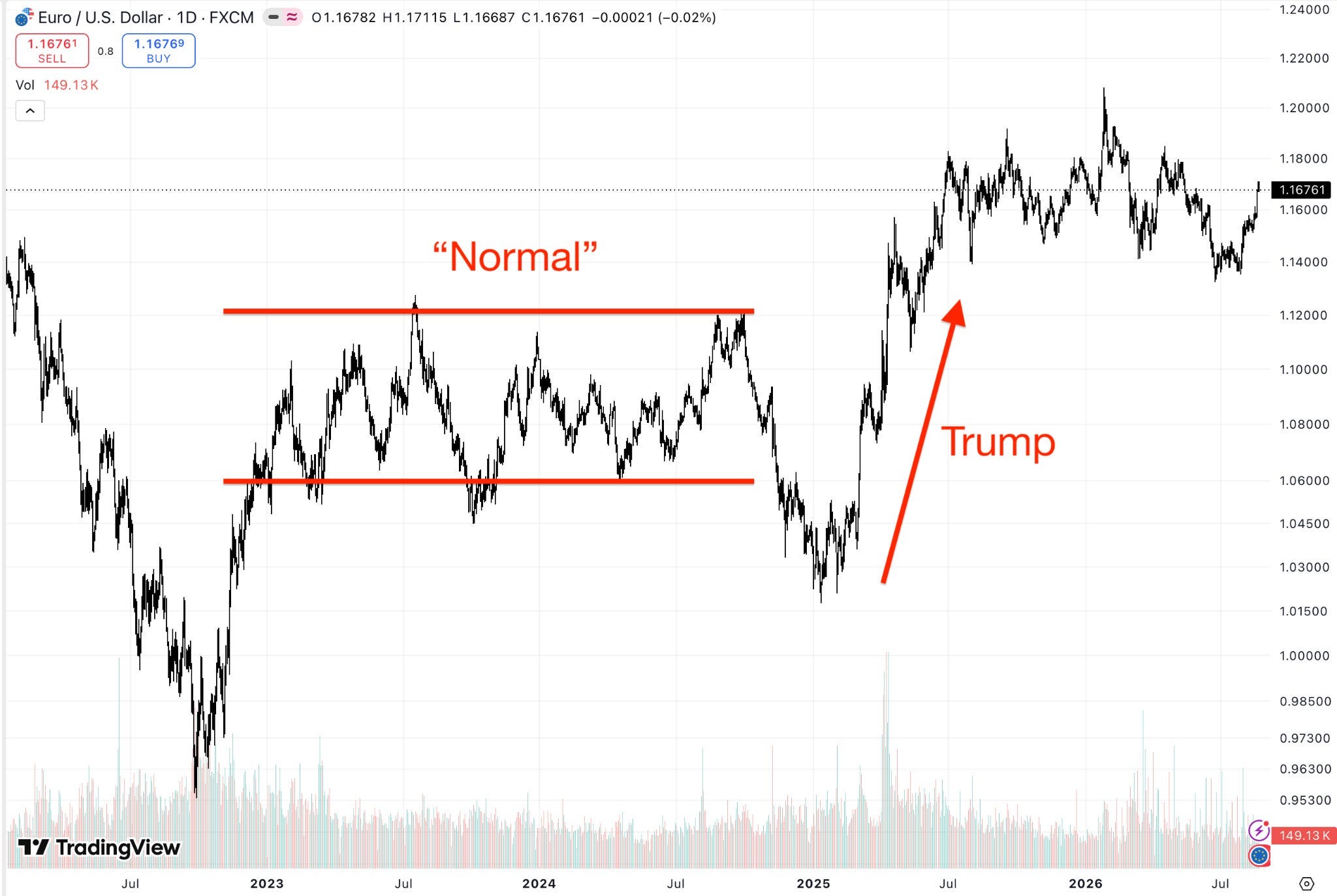
The only index funds I’d be comfortable holding are US index funds, which would introduce an additional risk for me. I monitor the EUR/USD exchange rate because I hold US stocks. They can go up or down by an additional 1% a day due to currency swings.
The rate I’ve always considered “normal” is 1,10. For most of 2023-24, the EUR/USD rate was between 1,06 and 1,12. But in 2025, it went from 1,02 to 1,19 and peaked at 1,20 in 2026. The reason for the weak US dollar is because Trump wants to boost export competitiveness and domestic manufacturing.
If you hold dividend ETFs, you never have to sell them. You never need to time the market. And the great news is that dividend payments grow over time.
3 reasons for that:
You add to your dividend ETFs every month
You reinvest your dividends
Public companies tend to raise their dividends
Give yourself enough time and your cash flow will blow your mind after a decade. That’s my time horizon (or longer).
Here’s how I selected 5 dividend ETFs.
My criteria for ETF selection
All my ETFs are domiciled in Ireland where the currency is the Euro. So there’s no currency risk.
Ireland also has special tax agreements with other countries, which lowers the taxes the fund pays on its investments:
Reduced withholding tax of 15% (instead of 30%) on dividends from US equities
No Irish taxes for non-residents on dividends or capital gains
But I still pay capital gains tax and dividend tax in Germany
Here are my criteria for selecting dividend ETFs:
Growth prospects of the 5-10 largest positions
Getting paid every month (even though individual ETFs pay quarterly)
Expense ratios below 0,5%
Dividend yields between 3 and 5% (neither too low nor too high)
Reasonable past performance to expect capital appreciation
Limited exposure to the US
A comment on the last point: Of course I want exposure to the US. The country has the most developed capital markets where the largest corporations trade. But then I wouldn’t really diversify my portfolio. So I made sure I have European and Asian companies in the ETFs as well.
Here’s a list of the 5 ETFs I own:
1/ Invesco EURO STOXX High Div Low Vol (purely European ETF with no US exposure)
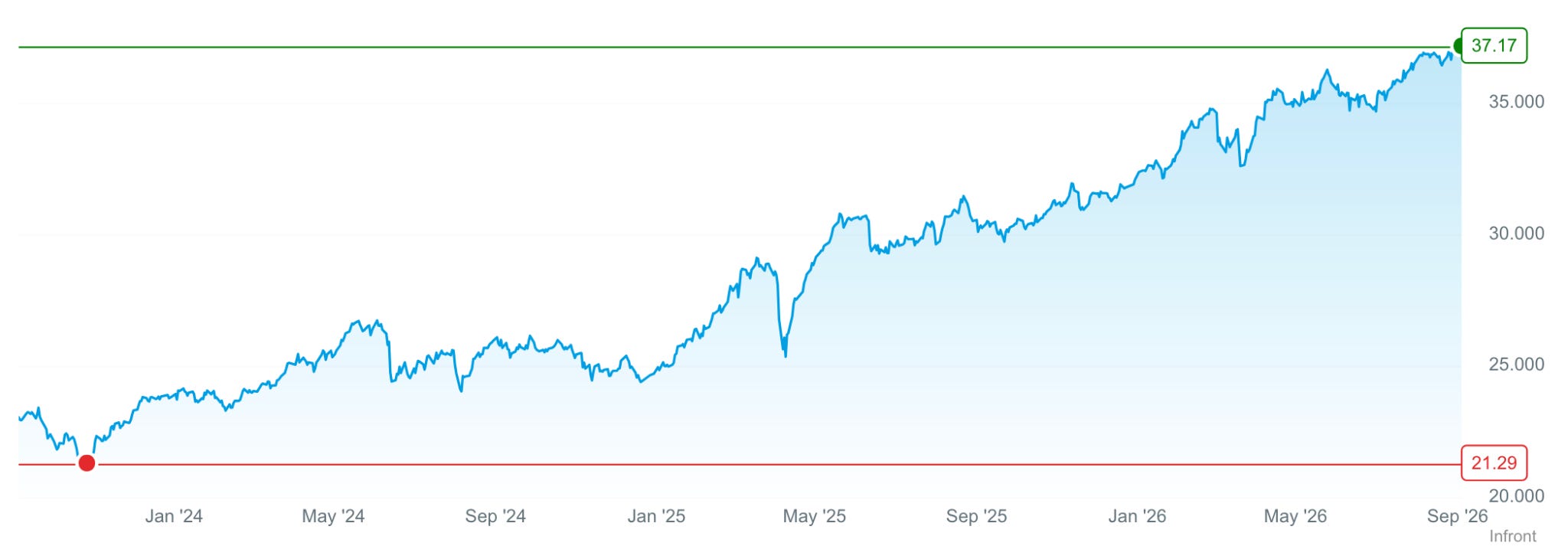
This ETF is based on European blue chips from financials, utilities, real estate, and energy. It’s the best performer in my portfolio. It has a yield of 3,5% and trades at an 11x earnings multiple.
This ETF uses a two-step filter. First, it isolates the top 75 highest-yielding stocks in the Eurozone. Then, it discards the 25 most volatile ones and keeps only the 50 most stable high-yielders.
2/ iShares STOXX Global Select Div 100 (21% of stocks are from the US)
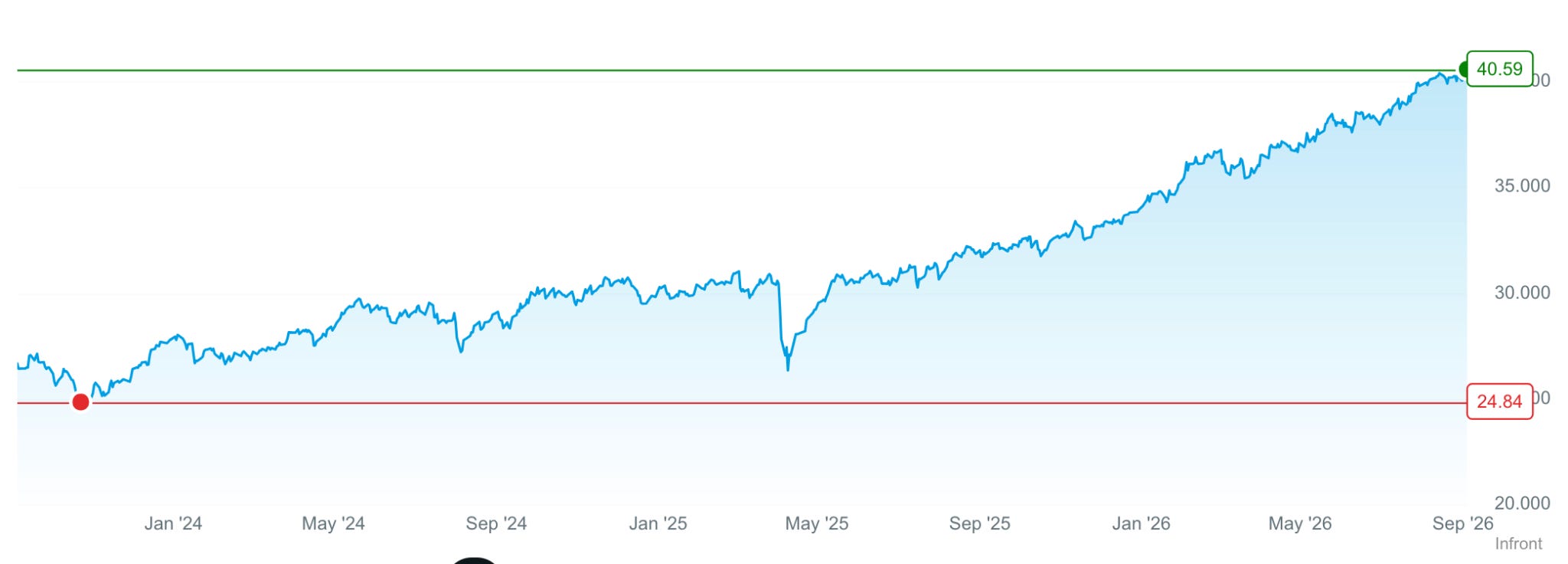
The ETF includes US stocks such as VZ, PFE, AMGN, and PRU. The yield is 3,8% and the average Price to Earnings ratio is 12.
The ETF weights its 123 holdings by their net dividend yield. Smaller, high-yielding dividend payers have a much larger weight in the portfolio compared to standard global indices.
3/ Vanguard FTSE All-World High Div Yield (40% of stocks are from the US)
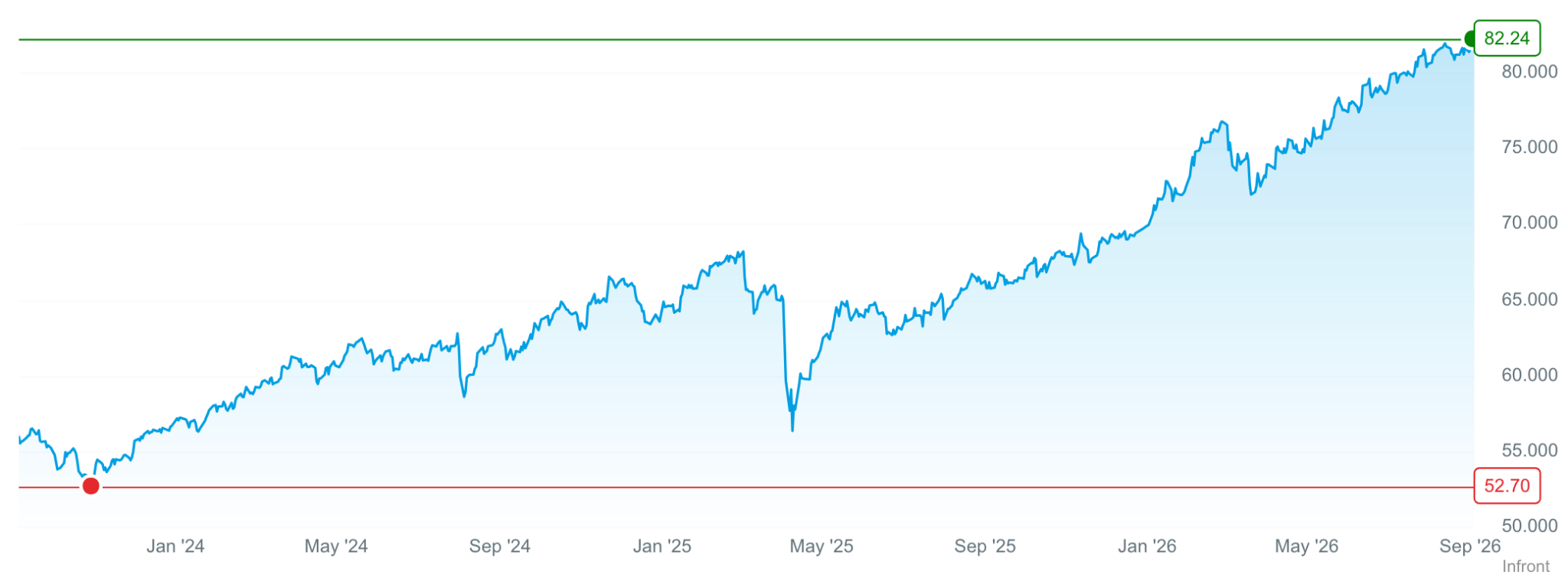
The ETF includes US stocks such as JPM, JNJ, XOM, CSCO, and MRK. The yield is 2,5%, Price to Earnings is 15.
The ETF is weighted by the market caps of the stocks that have higher than average dividend yields. This keeps stable megacaps at the top, which helps price stability.
4/ VanEck Developed Markets Div Leaders (23% of stocks are from the US)
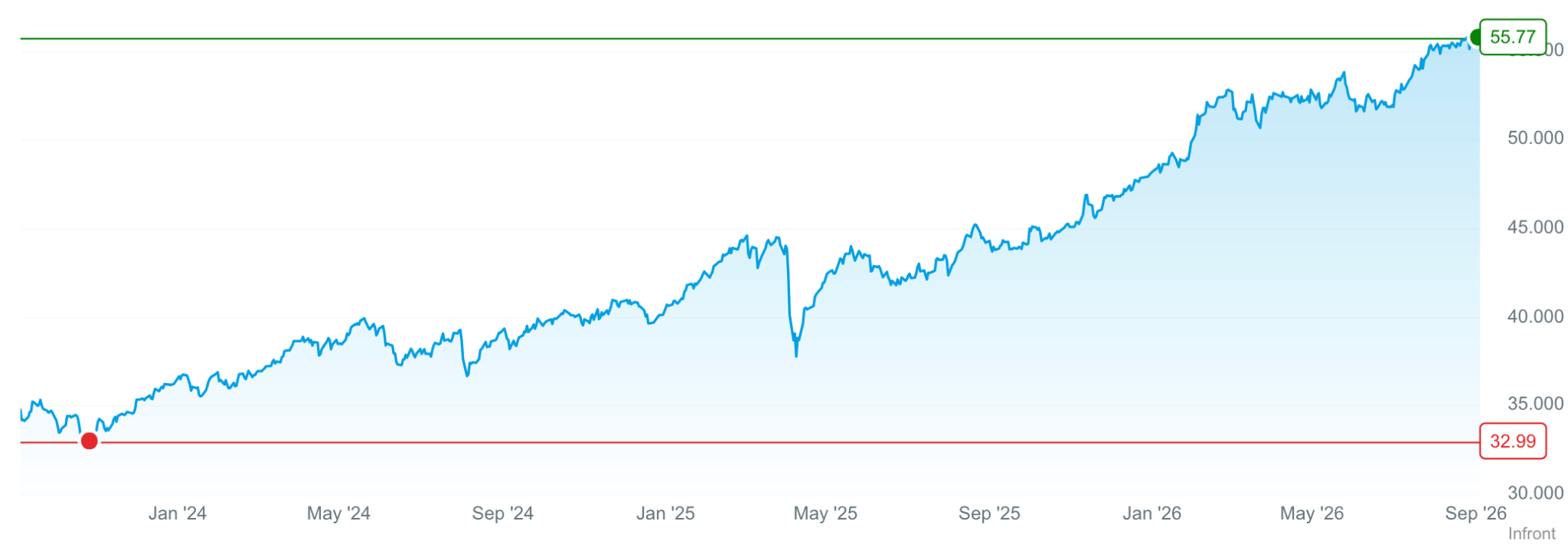
These are fundamentally strong dividend payers across international markets. Some of the stocks are VZ, PFE, and PEP. The yield is 3%, and it trades at 13x earnings.
The ETF offers global value diversification across both developed and emerging dividend payers.
The ETF weights companies by “dividend stream” which is calculated as tradable shares times dividend per share. The result is most are the companies that literally pay out the largest total dollar/euro amounts of cash dividends globally.
5/ SPDR S&P Global Dividend Aristocrats (52% of stocks are from the US)
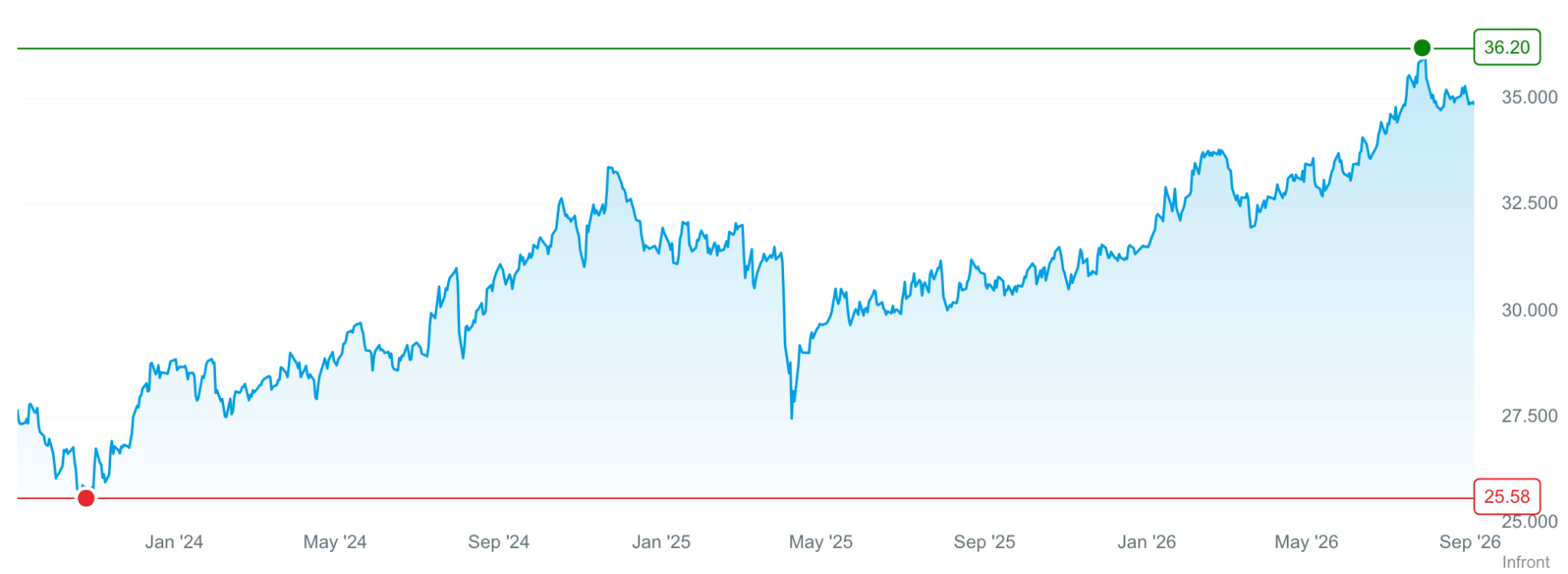
The foundation of this ETF is companies with long track records of increasing payouts.
In the US, dividend aristocrats must increase their payouts for 25 consecutive years. However, European and Asian companies rarely follow the US culture of steadily hiking dividends every single year.
To build a global fund, SPDR lowered the requirement to 10 consecutive years of increasing or maintaining dividends. This captures durable global businesses without excluding entire continents.
Some of the names here are VZ, PFE, UPS, and CVX. The dividend yield here is 4,6%. The ETF trades at 16 times earnings.
Some dividend yields seem a little too low, like 2,5% for the Vanguard FTSE ETF. This is the yield you’d get if you bought the respective ETF right now. I started buying them over 2 years ago when the yields were higher, between 3,5% and 5,5%. In the meantime, all of them have appreciated, which naturally reduced the yields. That didn’t change my investment strategy.
There are trade-offs to this investment strategy
There’s naturally some overlap in the companies various ETFs hold.
The argument against this strategy could be redundant management fees between 0.29% and 0.46%. While this is true, selling one ETF to add to another would mean creating a tax event (and losing 26,375% of my capital gains immediately) and reducing diversification.
For example, 3 ETFs hold VZ. Selling two of them because of one stock doesn’t make sense to me. The ETFs contain other companies from different continents. It’s the level of diversification I actually pursue.
Another potential downside of my dividend ETFs is they contain no Big Tech (no Microsoft, no Meta, no Google, no Nvidia, and so on). Those are the companies with the largest moats, and they still have insane growth potential. But their dividend yields are too low, and none of them are included in my ETFs. This means I’m missing out on some capital appreciation.
Capital appreciation is great but it’s not the main goal of my strategy. Goal number one is cash flow. As long as those dividend yields stay between 3% and 5%, I can buy roughly the same amount of ETF units every year. If the ETFs appreciate too fast, I’ll eventually buy fewer units, and my cash flow won’t grow as fast.
Better to be boring than poor
The strategy is incredibly boring but it works.
Since I selected the ETFs, I’ve been executing in the simplest possible way: Adding to them once a month as soon as my paycheck arrives.
Traditional advice is to automate your contributions. I didn’t do that. It gives me pleasure to manually transfer money from my checking account to my brokerage account. Every month, I add to one ETF I didn’t add to last month, and reinvest the dividends received.
The % of my paycheck I invest varies from month to month but it’s never below 25%.
I bought the first ETF in May 2024 and haven’t skipped a month ever since. I’d love to show you the time evolution of my portfolio but my broker (Degiro) doesn’t offer this option on a desktop.
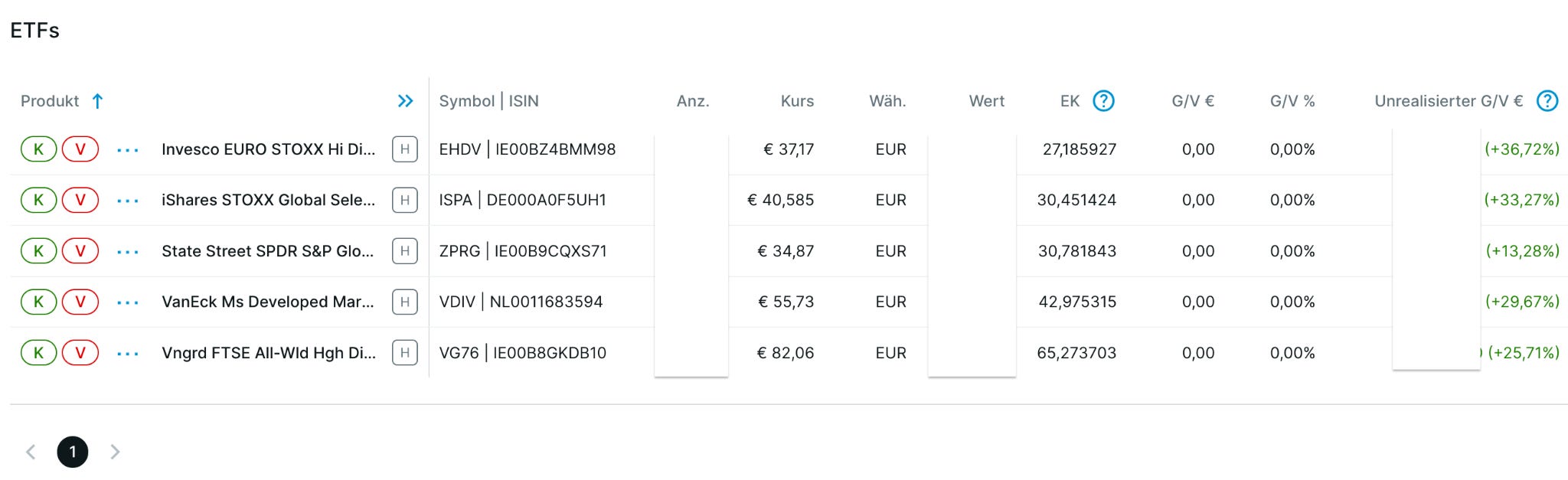
This screenshot shows the paper gains for individual ETFs without dividend payments. My net worth is steadily on the rise, and this is why I’ll continue to execute.
Final words
Figuring out my investment strategy took a few years and trial and error. I lost money in the process but found what works for me.
I’m happy with how my portfolio grows. The dividend payouts are on the rise, I have peace of mind, and I know the number of years I’ll need to reach my freedom number. More importantly, this strategy has vastly outperformed my earlier returns from buying and selling individual stocks.
The main message of my newsletter Stay Invested is to stay invested. Time in the market is more important than timing the market. To reach financial freedom, we talk about dividend ETFs, individual stocks I consider buying, and Bitcoin.
If this resonates, hit Subscribe. I’ll keep sharing what my dividend ETFs are doing, which stocks I’m buying and selling, and my long-term plans for Bitcoin.
–
This article is for informational purposes only. It should not be considered Financial or Legal Advice. Not all information will be accurate. Consult a financial professional before making any major financial decisions.
Subscribe to Stay Invested
Financial freedom is the goal. I provide you with concrete investment ideas to help you achieve it.
Good article. One remark is necessary, eu based investors may not buy most of us registered etf (documentary issue). Only sell them or get assigned through option strategies (such as selling puts). Equivalent ucits (eu registered and approved) are less liquid
Great point to make around chasing yield - I made a similar argument today: https://danlanetalksmoney.substack.com/p/beyond-3-12-multi-decade-income-heroes