


How does a consistently market-beating strategy work? In my first two articles I described the system behind the MarketFighter Strategy, the historical track record and how I achieved it.
If you missed them, you may want to read this article first:
My investment approach that outperformed the stock market in 25 of 26 years
Today, I’m opening the hood. I’m revealing the exact universe of assets that makes the MarketFighter Strategy tick. The same 15 indices and two baskets that allowed for a 25-of-26-year outperformance and a +20% CAGR over the past 10 years.
The MarketFighter Universe
The strategy exploits a systematic momentum-based edge, which can be found in many areas of finance. Our focus is on the two segmentations of stocks called Factors and Sectors. These are easily accessible for retail investors through focused ETFs.
We don’t utilize all possible sectors and factors. Instead we focus on those with the best and most consistent historical track record. We want to invest in assets that tend to outperform the market in trends that can be recognized by the system.
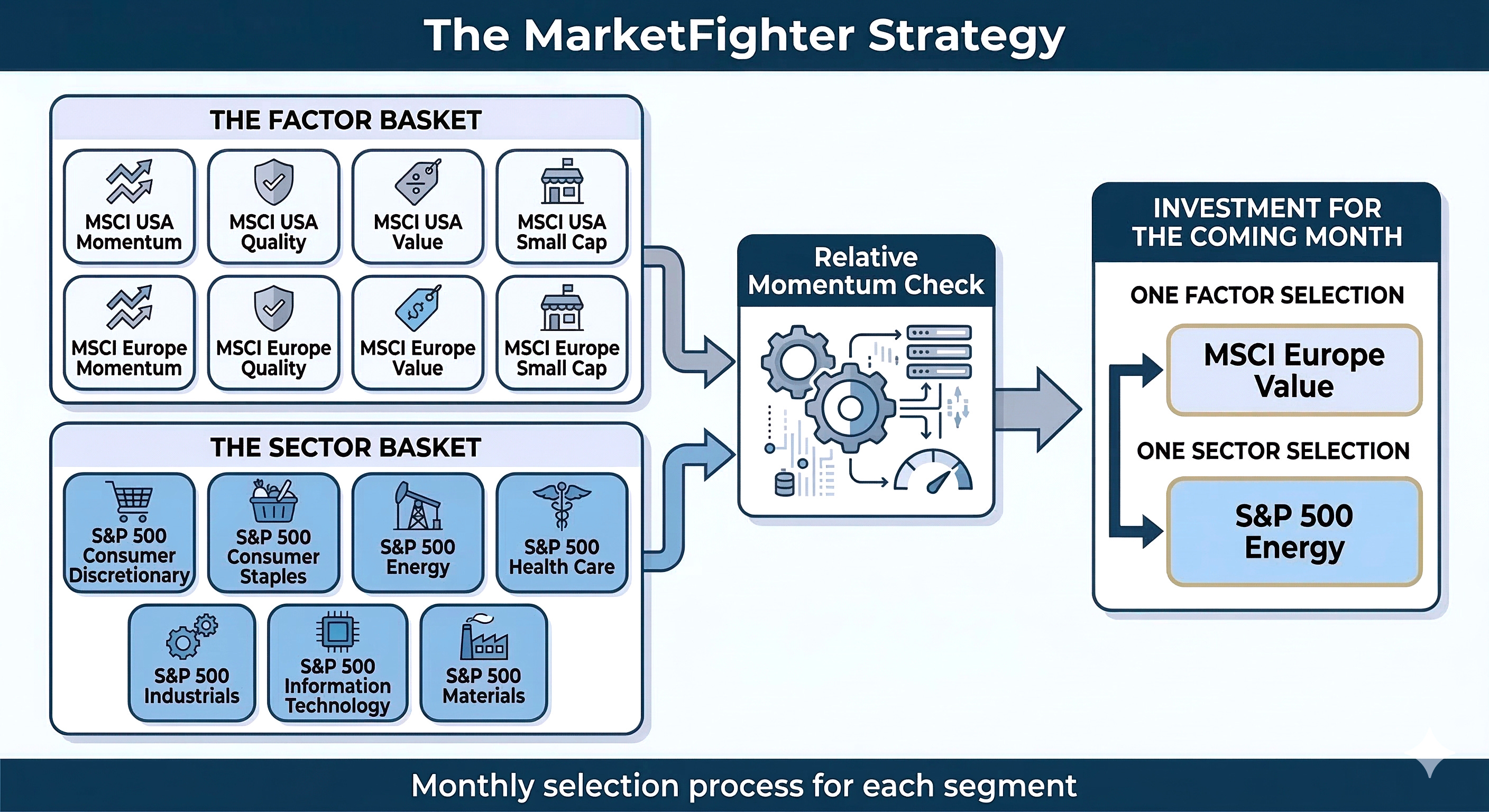
Therefore, in both segmentations we work with a preselected basket of indices (which can be tracked using ETFs). These baskets are fixed and look like this:
🎯 The Factor Basket
MSCI USA Momentum Factor
MSCI USA Quality Factor
MSCI USA Value Factor
MSCI USA Small Cap
MSCI Europe Momentum Factor
MSCI Europe Quality Factor
MSCI Europe Value Factor
MSCI Europe Small Cap
🏅 The Sector Basket
S&P 500 Consumer Discretionary Sector
S&P 500 Consumer Staples Sector
S&P 500 Energy Sector
S&P 500 Health Care Sector
S&P 500 Industrials Sector
S&P 500 Information Technology Sector
S&P 500 Materials Sector
Why the specific factors?
You may know that factors represent characteristics identified by academic research to have a high probability of near-term outperformance compared to the broader market. There is a wealth of empirical evidence supporting this.
Specifically Momentum, Quality, Value and the Size (Small Cap) factors all have strong historical performance over long time horizons, and all four of them represent risk premiums caused by basic behavioral biases — these will most likely never disappear.
The split between US and Europe is a way to capture the market trends, and there’s a tendency for the market preferring either US stocks (which has generally been the case since 2008) or European stocks (which has been the trend lately).
These two markets together make up ~85% of the total developed market, and splitting factors between the two opens up for better opportunities for taking advantage of market-specific trends.
Why the specific sectors?
All US stocks can be categorized into one of 12 well-defined sectors. The historical performance and trends within in each sector is documented and can easily be analyzed.
Sectors tend to move up and down in trends, but some more than others. My research has revealed the seven selected sectors above represent the best combination of assets for capturing long term alpha (outperformance).
This happens because they follow different patterns and react differently to macroeconomics, changing interest rates, and media narratives. When one of them is underperforming the market, others are outperforming.
The system detects when to jump to the next wave based on historic probability caused by the recent relative momentum.
Past versus future
Be aware that both of these baskets are selected based on historical data.
I have a mindset of never attempting to predict the markets. The only information we have available is historical data, so we have to get the best out of this.
Since the patterns we exploit have been remarkably consistent over multiple decades, there should be a good probability that they may continue this. But as always, there is no such thing as guarantees in investing.
Finding the right ETFs
You may wonder why the process deals with indices and not ETFs. This is because I’m writing for a global audience, and investors don’t have access to the same ETFs in all countries.
To follow the strategy, you just need to find an ETF on your trading platform that tracks the relevant index. In a future post I will provide lists of ETFs specifically suited for investors in Europe and in the US. Readers from other parts of the world will most likely have access to similar products.
The monthly signal
This system could be traded and rebalanced at any possible frequency or time interval. It could most likely be optimized for even better returns if you dig into alternative time frames. What I wanted to achieve, however, was a system so simple and easy to use, that anyone will be able to follow it.
That’s why I settled on only using monthly signals. This means we will only have to check the system — and potentially make a trade — once a month.
At the closing of each month, I run the algorithm that does the momentum check. In most cases the outcome is two ETFs to invest in for the coming month. Often one or both of them will be identical to last month, which means you don’t have to execute any trades.
On rare occasions the system will tell us to go cash to protect our capital in one or both of the sector/factor segments. This only happens if we are in significant market declines and it recognizes the same pattern of negative momentum that historically has been synonymous with high probability of continued declines.
Your job
So, what’s your job? First of all, make sure to subscribe, so you don’t miss a monthly signal.
The only thing you have to do after this, if you want to follow the strategy, is to execute the trade as suggested by the monthly trading signal (if the signal differs from the previous month) and make sure to allocate 50% of your money into each ETF.
Then you have to stick to the strategy. This may sound easier than it is, as all trading strategies (yes, even this one) has periods of relative underperformance compared to the market. If you trust the consistency of the historical returns, remind yourself that there will be good and bad months on the way.
✅ Here is your checklist:
Subscribe to receive the trading signals (it’s free!)
Check your inbox when the signal arrives each month
Check your existing holdings
Execute the trades needed (if any) to follow the signal
Wait. Be patient. Repeat the process next month.
“The stock market is a device for transferring money from the impatient to the patient“
— Warren Buffett
Finally, you will have to accept that this strategy may be boring. Not everyone can handle the FOMO of not buying the hot stock picks of the time as most other investors do. But if you have a long term mindset, you possess the most important ingredient in getting success with a strategy like this.
Disclaimer: The MarketFighter Strategy is for educational and informational purposes only. It is not financial advice, and the author is not a licensed investment advisor. Investing in ETFs involves significant risk, and past performance is never a guarantee of future results. You are solely responsible for your own trades and financial outcomes. Read the full Disclaimer here.
Thanks for all the detailed information. Of note, I think it’s very important to inform subscribers that the system is based on buying the ETFs on the first day of the month— because it makes a difference. I bought XLE on June 2 and that was quite different than buying on June 1. I think I asked about this in May before subscribing, and you recommended buying at least in the first day or two. It’s important to Inform subscribers that the system is based on purchasing the ETFs on the first day of the month and purchased by the end of the day-if that is how the system is set up. Otherwise, people may get very different results. Perhaps it all comes out in the wash and that’s something you could also address—as sometimes their purchase price could be better, rather than worse. And, as markets fluctuate during the day, perhaps it would be helpful to know exactly how you calculated back testing by indicating the timing of the etf purchase.