


Most investors fail before they even place their first trade. Not because they lack intelligence or capital, but because they pick a fight they don't have the time or resources to win.
They try to out-research Wall Street next to a full-time day job. They try to time the market with a gut feeling that changes with the news cycle. They’re playing a professional's game with a hobbyist's schedule.
It’s time to take off the blindfold and find an approach that actually fits your life. Today, I’m putting the world’s most popular investing styles under the microscope to find a strategy that matches your personality and your return expectations.
Let’s get to work.
The truth about strategies
Success in the markets is not just a matter of high intellect, but also about playing the right game. Most retail investors are playing a game where the odds are stacked heavily against them. Here’s the truth that Wall Street doesn’t tell you:
Every investment strategy comes at a price — a burden you have to take, which is measured in your hours, your stress levels, and your mental bandwidth. What you need is a strategy that works specifically for you.
To find this, you have to be humble and honest about your own weaknesses. If you keep grinding, but feel you’re getting nowhere, it’s probably because you’re paying a price you can't afford for a game you weren't built to play.
Now, let’s walk through the most common strategies and their hidden prices.
#1: Passive Index Investing
Buying a simple index fund or ETF that simply tracks the S&P 500 or the MSCI World Index has become increasingly popular in recent years. It removes the entire workload from the buyer, and it doesn’t require any specific knowledge. Anyone can play this game.
Research even shows index investing outperforms most professionals and fund managers. But where many people fail is during the occasional deep market declines where it can be tempting to sell out — only to wait too long before entering the market again when the train has already passed.
At the same time, the index investor has to accept they will never beat the market, and that there’s a natural ceiling to their returns. The urge to sell out during declines or to move into higher performing stocks has to be controlled.
✅ Pros: Easy, low effort, no skills required. Performs better than most professionals.
❌ Cons: It’s boring and you have to accept you’ll never beat the market.
⚠️ The hidden price: Lack of control, opportunity cost and FOMO from high performing stocks. Requires patience and discipline not to sell out.
➡️ Conclusion: A rock-solid choice for those who are truly content with market averages and have the iron stomach to do nothing when the world feels like it’s ending. But if you’re looking for outperformance, this strategy won’t cut it.
#2: Active Stock Picking
The standard for stock market investing. Active stock picking is a very broad term that actually covers many focused sub-strategies such as value, quality, growth, momentum, or contrarian investing, along with various forms of technical analysis.
For the select few Warren Buffetts out there, stock picking can lead to outsized returns and remarkable performance. This is what we all dream about. The enemy is often our ego and our perception of our own intelligence.
In psychology, this is known as the Dunning-Kruger Effect: The cognitive bias where individuals with limited knowledge or competence in a domain greatly overestimate their own expertise.
As a retail investor you are up against supercomputers, AI, PhD researchers and professional 90-hour-workweek analysts. Our odds of winning at this game are very low. On the positive side, the fun and entertainment of this style is much higher than for index investing.
Succeeding is not impossible, but you need to have a very strong edge — some knowledge or ability that clearly brings you ahead of the crowd. If you don’t know what your edge is, chances are you will eventually lose your money to the bigger fish that actually have an edge.
✅ Pros: Fun and entertaining. Theoretical possibility of getting rich quick.
❌ Cons: Your competition in this field is huge. You are David vs. Goliath.
⚠️ The hidden price: You pay in hours and ego. The workload needed to stand a chance in this game is beyond a full-time job.
➡️ Conclusion: Do this for fun, education and entertainment and for the intellectual rush. But I don’t recommend investing your entire portfolio like this, unless you are one of the select few.
#3: Day-Trading
Speaking of games, day-trading is a completely different beast. It’s not about investing in the market or in companies for business reasons. It’s much more speculative and the mental barriers to succeeding are extreme. It typically involves buying and selling the same assets again within hours, minutes or even seconds.
What draws people to try day-trading is almost always the thought of getting rich quick. And in theory this is possible. Theoretically, you can earn the same amount by day-trading for one day, as you can by index investing for a decade.
Data shows only about 1% of day-traders make consistent profits in the long run. The fraction that actually make big money is even smaller. The problem is day-trading is a high-stress job with no guaranteed salary. You constantly have to worry and the mental load is extreme. 95% of day-traders fail within two years.
✅ Pros: The excitement and the idea of getting rich quick.
❌ Cons: Requires heavy tooling, heavy workload and a superhuman mentality.
⚠️ The hidden price: When things get tough, this strategy is extremely hard on your mental health and this makes most people quit.
➡️ Conclusion: My recommendation for 99.9% of people is to stay away from this strategy. It’s dangerous for your capital and your health. Only do this if you have the mental strength of a mountain.
#4: Dividend investing
You can argue that this could be categorized under stock picking, and you’re not wrong. But I often see people investing primarily for the dividend in a company and not for the business value.
The idea of an income-generating portfolio of dividend stocks is great if you are retired and want a steady flow of money without selling stocks all the time.
The other argument often cited is that high-dividend stock historically outperformed stocks with no dividend. While it’s not wrong that this used to be the case, the reason for the outperformance could typically be attributed to the profitability and valuation of the companies, not particularly the dividends.
Dividends are not a free lunch. The amount that is paid out to the investor is withdrawn from the stock price. This means a dividend payout is equivalent to selling a small fraction of your holdings in a stock. This is very important to understand.
✅ Pros: It feels good to receive regular income. Makes sense for retirees.
❌ Cons: There’s no added value in dividends. Your returns are still tied to the returns of the stocks you selected.
⚠️ The hidden price: In many cases, you are just watching the “left pocket” pay the “right pocket” while the share price stagnates. Often the dividend is high because the company is not doing well.
➡️ Conclusion: For retirees it can make sense. If the stable income makes you feel good, it can make sense as well. But for optimizing long-term wealth, there’s no benefit to dividend investing.
#5: Systematic or data-driven investing
Most investing approaches involve a lot of qualitative analysis, gut feeling and guessing. The systematic or data-driven investor attempts to eliminate this through mechanisms to signal when and what to buy or sell.
The first half of this involves finding a strategy with a consistent edge, meaning if you follow the strategy long enough, you can expect to beat the market. The second half is about sticking to the system, even when the suggested trades feel counter-intuitive.
The idea is to find repeatable patterns in historical data. If a certain pattern tends to be followed by gains, you can trade it. You move your focus away from analysing companies and markets to analysing data. It’s all about figuring out which factors or parameters have caused future outperformance with the highest possible probability.
This is a probability game, because there is no way you can predict the markets. The hard part is finding an edge with a high probability that you can actually trade. There are many pitfalls to this, from overfitting a backtest to simply not having the stomach to cope with the inevitable drawdowns and relative underperformance.
But if you can find a systematic approach with a long and consistent track record that resonates with your personality, all that’s needed is your ability to stick with it.
✅ Pros: If you’re in it for the money, this strategy has the highest expected returns with the lowest effort (depending on the system).
❌ Cons: No entertainment and lack of intellectual excitement or the ego-boost of being in total control.
⚠️ The hidden price: Looking at average returns of a system may seem promising, but beware of the drawdowns. You have to be able to stick with the strategy, even when it feels wrong.
➡️ Conclusion: This is an overlooked option for many retail investors. If you’re investing for entertainment, this is not for you. But if you’re serious and in it for highest returns, this could be your winning strategy.
Why the paradox exists
The paradox is that the most “exciting” games (stock-picking, day-trading) are usually the ones where you have the lowest chance of winning. Meanwhile, the “boring” systematic approach—the one most people ignore—is actually the one designed for the highest probability of success.
What people often miss is the hidden price of a strategy. We focus on the upside, the ceiling and the potential returns a strategy may deliver. Much less the risk, the effort needed and the burdens it puts on us.
My revelation
I strongly believe our chances of succeeding in the markets are highly aligned with choosing the right strategy that fits our personality, our strengths and our mentality.
Personally I spent many years trying out these strategies, playing the wrong games and fighting the markets. You can read more about my journey here. Ultimately, I was never able to beat the market — until I finally had a breakthrough:
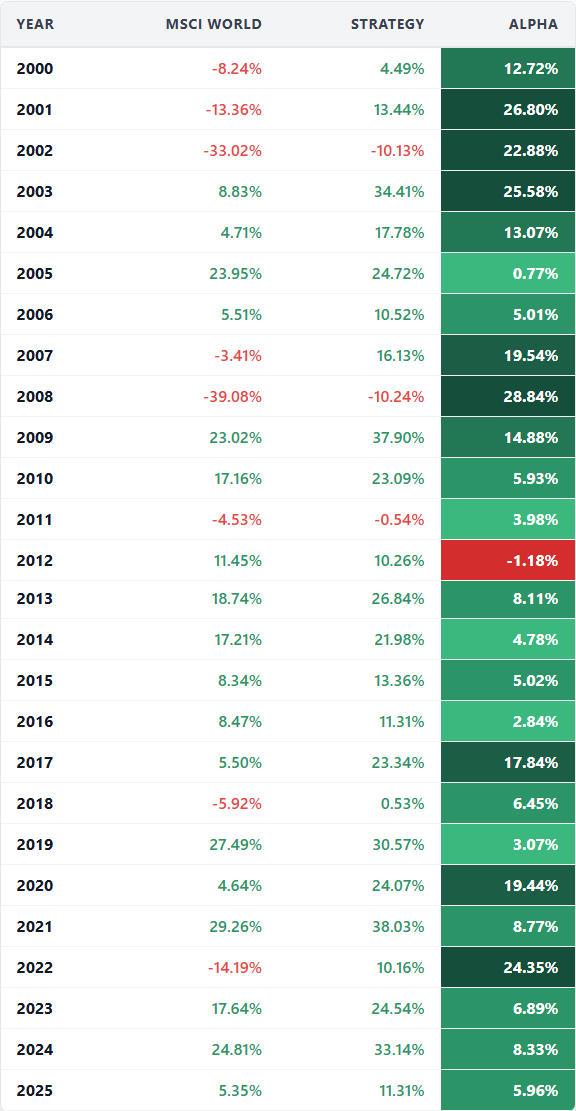
With the goal of securing financial independence, the big revelation for me was realizing I was able to build a systematic strategy that outperformed the market with high consistency and eliminated emotion and bias.
Knowing my personality and my (low-to-medium) risk appetite, I knew such a system could only work for me if the expected drawdowns were lower than for the general market. The table below shows the returns my system has delivered. 2000-2020 was backtested, while 2021-2025 is real trading:
You can read more about the simple system behind these results here:
➡️ My investment approach that outperformed the stock market in 25 of 26 years
If you want to join me and believe this strategy could be a fit for you too, just subscribe below to receive the free monthly trading signals in your inbox.
Disclaimer: The MarketFighter Strategy is for educational and informational purposes only. It is not financial advice, and the author is not a licensed investment advisor. Investing in ETFs involves significant risk, and past performance is never a guarantee of future results. You are solely responsible for your own trades and financial outcomes. Read the full Disclaimer here.
Good read! I spent my fair share of time fighting the markets too before switching strategies. Expensive lessons 😬
The paradox is real. Most investors optimize for feeling smart rather than generating returns. A systematic approach solves this. The system makes the decision. You just execute. Ego exits the trade.