


Hi, and welcome to my newsletter! 👋
I’m an independent investor and software engineer in my 40s, who was recently able to quit the 9-to-5 thanks to my investment strategy. I write about my journey, my strategy, and my trades for anyone who wants to follow my path.
In today’s post, I will reveal the scary numbers that show just how badly the average retail investor performs. I will uncover the traps that most people fall into, and give you the secrets that significantly improved my own returns.
New to The MarketFighter Strategy?
I write about a simple approach to beat the stock market with only 15 minutes of monthly work that anyone can copy. Check out these links:
➡️ The quick introduction
➡️ The beginner’s guide
➡️ The detailed breakdown
What are the returns of an average investor?
Over long time horizons, the stock market grows at an average of 7-10% annually, depending on whether or not you adjust for inflation.
Intuitively, you would think this number would be the expected average return for investors. But it’s not even close…
Numerous studies have shown that even professionals and fund managers have a hard time competing with wide market indices like the S&P 500 or the MSCI World in the long run. For instance, only 6% of active fund managers beat the S&P 500 over a 20-year period.
The chart below is from the widely cited Dalbar Studies, which measure the average performance of investors like you and me, and compare it to popular asset classes:
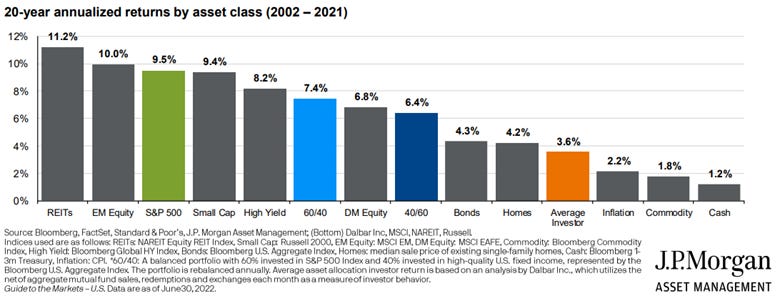
The numbers that are interesting from our perspective are these two annual returns, averaged over a 20-year period:
🟩 The stock market (S&P 500): 9.5%
🟧 The average investor: 3.6%
That’s a gap of 5.9% of “lost” returns every year for the average investor. While this is uncomfortable already, the comparison gets much worse in the long run when compounding effects kick in.
Below are the profits of an initial investment of $10,000 over a 20-year period based on these numbers (not accounting for fees and taxes):
🟩 The stock market (S&P 500): $51,416
🟧 The average investor: $10,286
Think about this: Over a 20-year investment period, the average investor will only see one-fifth of the market returns, leaving more than $41,000 or 80% of the average market returns on the table!
Why is investing so difficult?
Maybe you wonder how the math adds up. How can the average investor not make the same returns as the market average delivers?
Briefly explained, it’s because market returns are heavily skewed: A small number of high-performing super stocks account for the vast majority of the market returns. Meanwhile, the average return of the remaining stocks is much lower.
In other words: If you don’t happen to pick one of the super stocks of the coming decade(s), it’s extremely difficult to beat the market, or even keep up with it. This was famously revealed by Hendrik Bessembinder in his studies of market returns.
This means stock picking becomes a loser’s game, unless you possess a real edge: Some sort of knowledge, skill or information that gives you an advantage compared to other market participants. But the choice of stocks is not the only problem…
Programmed like animals
Even if we outsource the choice of stocks and simply buy market-wide ETFs, we’re faced with another challenge.
Not so long ago (from an evolutionary perspective) our ancestors still roamed the savanna as hunter-gatherers, focusing on survival and hardwired to stay constantly alert for predators.
Human beings are programmed like animals: To be controlled by fear and greed. From an evolutionary perspective on the savanna, this made a lot of sense. There’s just one problem: Evolution did not prepare us for financial markets.
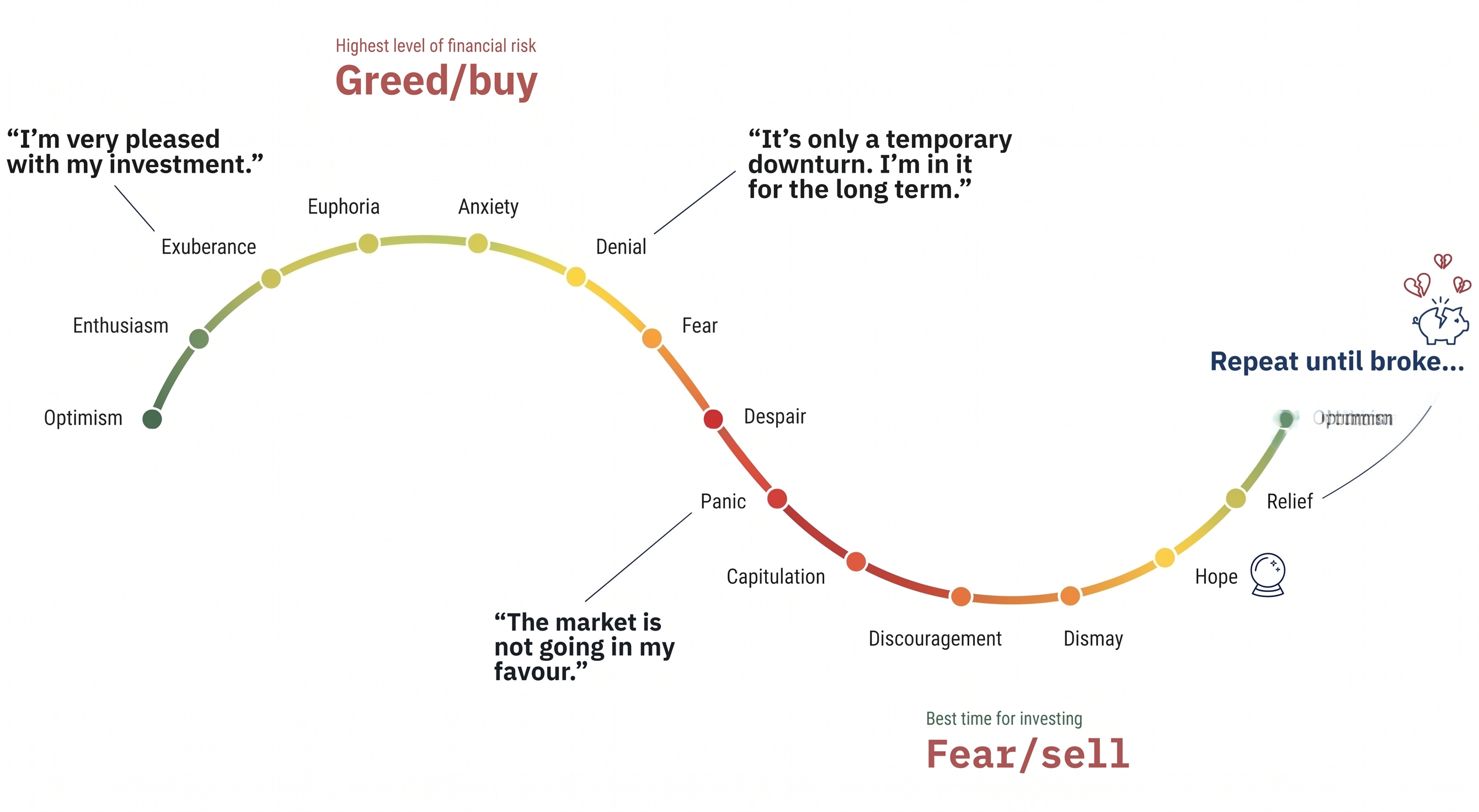
On the stock market, fear and greed drag us in the wrong directions. When the news is bad and the market is low, our natural fear tells us to sell — often at the worst time. And when everything looks bright and the market is thriving, our greedy nature wants us to buy — at times that often seem unlucky in hindsight.
This becomes a constant fight between our brains and our natural instincts. And our brains are more often affected by instincts than most people are aware of. The result is that we try to time the market. And humans are inherently and biologically bad at market timing.
The Dunning-Kruger Effect
The odds are stacking against us. On top of the skewness of returns, the low probability of identifying tomorrow’s winners, and our natural instincts working against us, we have another headwind coming, known as overconfidence bias.
There’s something magnetically enticing about trying to predict the future. Everyone seems to have an opinion on what will happen. Without any deep knowledge on a subject, it’s common to hear people make predictions about:
When the stock market is going to crash
What’s about to happen with housing prices
Where the Nvidia stock will be in a year
Who will be the winners of the AI race
How the USD will fare relative to the EUR
And it’s not a phenomenon specific to financial markets. It’s a common human trait that we overestimate our own knowledge on a subject and our ability to predict future events based on this knowledge.
This is known as The Dunning-Kruger Effect: The cognitive bias where people with limited knowledge or competence in a specific domain overestimate their own abilities, while experts in that domain tend to underestimate theirs.
Or in my own simplified phrasing: The more you know, the more you know that you don’t know.
This leads us to think we are much more capable of thriving in the markets, timing the ups and downs and predicting the future winners, than we are.
I believe most people are affected by this way of thinking. I’m no exception from the rule, but being aware of its implications, I try my best to stay away from making investment decisions that will be affected by psychology of any kind.
The easy way to beat the average
In the beginning of this article, I promised to give you the secrets to get significantly higher returns than average investors. It’s time for the most important one:
The trick is to eliminate fear, greed, and overconfidence bias from your trading decisions.
How do you do this? It’s not as easy as it may sound. Manually picking a stock and timing the buying and selling are heavily affected by emotion, instincts and biases.
The easiest way to avoid them (and I’m sure you’ve heard this one before) is to simply buy an index (ETF) and hold it. This recommendation has gained a lot of traction over the past decade. The so-called Bogleheads community has a simple recipe for this:
Buy a low-cost index fund
Dollar-cost average into it
Stay the course
Buying that index ETF is the easiest part. The harder part can be to stick to it no matter what the market does. Our human psychology will still try to affect our desire to sell it all when the market is in panic mode.
If you can manage this (only buying and never selling until you need the money) you will end up with long-term returns that are close to the market returns, and significantly better than the average investor!
How I took it one step further
While index investing is considered highly recommended for most people, some will find it boring, and some people just can’t seem to settle with something that is pretty good but not amazing.
Personally, I belong to the latter group. I’ve been active on the stock market since 2004 and tried all the common strategies with limited success. I’ve kept learning and studying, and today I know why I didn’t succeed back then.
If you have followed my newsletter or read some of my other articles, you will know that I developed my own systematic strategy back in 2021, which I have followed strictly since then.
This strategy takes the knowledge of human instincts and biases into account, and instead of falling into the traps, it reverses them, utilizing the human behavior in markets to its own benefit via a set of simple mathematical rules.
My strategy has more than doubled the market returns since I started following it in 2021, beating the MSCI World index every year so far.
I only spend 15 minutes every month, executing an average of 9 portfolio changes (swapping one ETF for another) a year. By popular demand, I have put together an introduction to my strategy here:
➡️ The Beginner’s Guide to the MarketFighter Strategy
I hope you enjoyed this article. Subscribe for more insights like this and to follow my investment strategy and its monthly trading signals.
Thanks for reading!
Disclaimer: The MarketFighter Strategy is for educational and informational purposes only. It is not financial advice, and the author is not a licensed investment advisor. Investing in ETFs involves significant risk, and past performance is never a guarantee of future results. You are solely responsible for your own trades and financial outcomes. Read the full Disclaimer here.
Your strategy really generate Alpha against the MSCI World Index but can you kindly show the results of your strategy against the S&P 500 Index?
I understand your selection for the MSCI World as the benchmark, just curious how it performs against SPX.
The full name of Dollar Cost Averaging
= Averaging on the Discount on Dollar Worth Opportunity Cost
= Averaging on the Discount on Opportunity Cost
.
When Opportunity Cost < 1, averaging down.
.
When Opportunity Cost > 1, stop averaging down.