


Every month I send out a performance update for the MarketFighter Strategy: The investment approach I have followed for the past five years, which I’m now sharing with all subscribers to this newsletter.
In this post, I will give you a transparent look into how the strategy performed in April and how far we are ahead of the market in 2026 so far.
New to The MarketFighter Strategy?
I write about a simple approach to beat the stock market with only 15 minutes of monthly work that anyone can copy. Check out these links:
➡️ The quick introduction
➡️ The detailed breakdown of the strategy
April was a wild ride
Following a deep decline in March, the global stock markets rebounded sharply in April in what became the strongest month for stocks since November 2020. Here is our monthly performance so far in 2026 compared to our global market benchmark, the MSCI World Index:
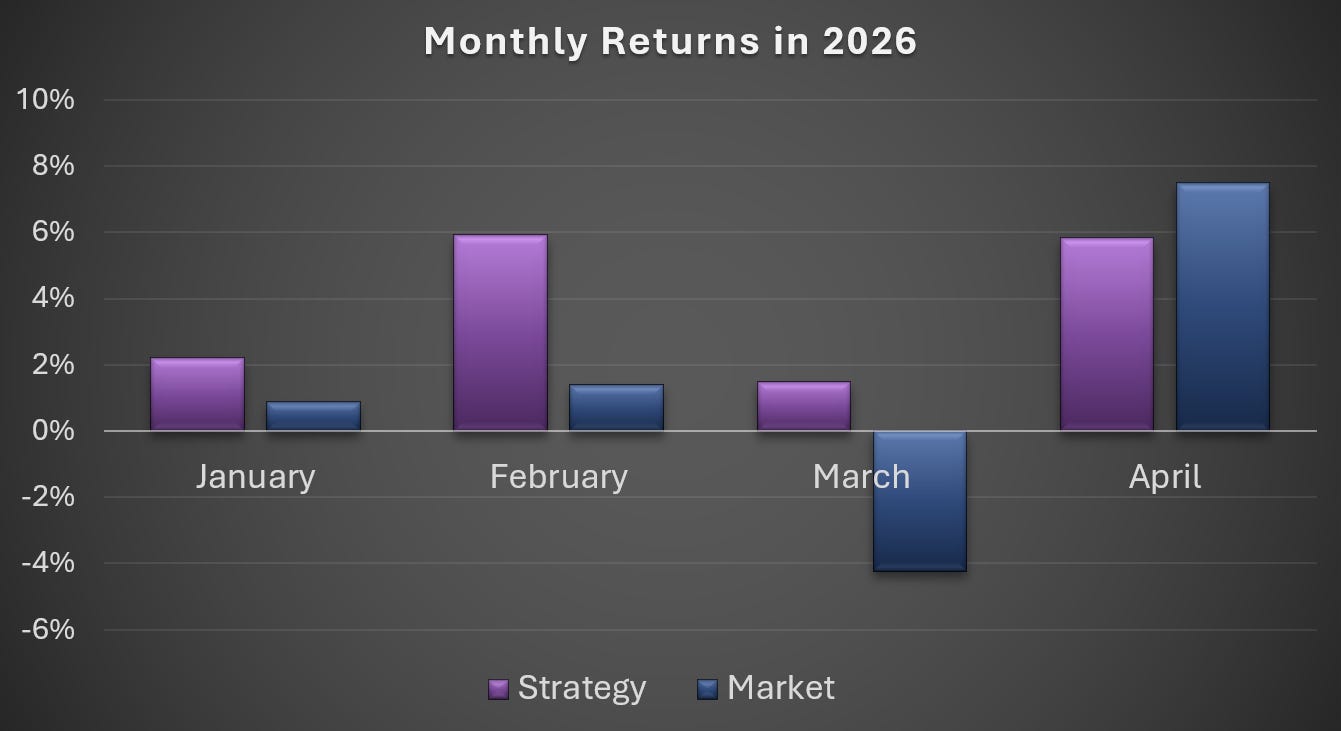
After three consecutive months of solid outperformance, we lagged the benchmark in April, despite a high return for the month of 5.85% for the strategy. The relative underperformance was caused by the Energy ETF, which came down from recent highs due to volatility in oil prices.
We still haven’t experienced a negative month this year, and we are still comfortably ahead of market returns year-to-date (see the table further down in this article). Any strategy should of course be measured in years and decades, not in months. I’m just sharing these numbers for people interested in the latest development.
Detailed monthly breakdown
In the table below I have provided the exact performance of our strategy on a monthly basis compared to the MSCI World Index, as well as the alpha (the difference between our return and the market return):
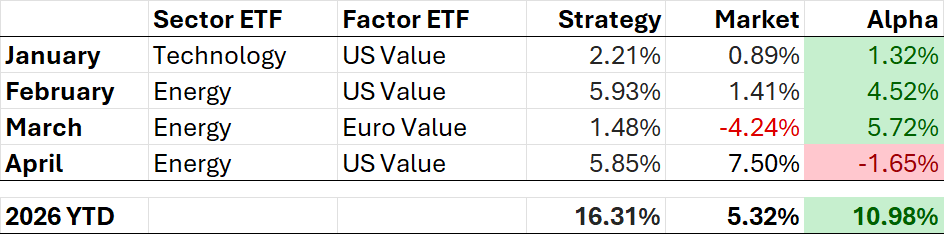
Despite the first negative month relative to the benchmark, the strategy is up more than 16% so far in 2026, and more importantly almost 11% ahead of the MSCI World Index. This means we are in a good position to achieve a 14th straight year of outperforming the benchmark.
➡️ See this article for the full return overview of each year
The table above also lists the allocation in each month. These are the two ETFs the system decided to allocate money into based on the relative price momentum rules that are the foundation behind the strategy.
You can read more about the investment universe and the 15 indices and corresponding ETFs the strategy uses here:
➡️ Indices and ETFs in our investment universe
If you’re looking for the May trading signal and curious about which ETFs the strategy is currently allocated to, I wrote a separate article here:
➡️ The May 2026 Trading Signal
The hardest part: Doing nothing
Finding a good strategy for trading and investing is only half the job towards success. The other half is all about having the discipline to stick to it. This is a theme I will be digging deeper into in future posts.
When I mention this now, it’s because I know that followers of the strategy may have a hard time sticking to an investment with high volatility that started to move down after a big surge.
I’m talking about the Energy ETF. In April, it went through a heavy decline, while the market surged. This is never a good feeling.
Eventually, it regained some of the losses at the end of the month, but I suspect the urge to sell it prematurely was present for many. It was for me. However, I have learned from experience that when it comes to trading, I’m better off trusting the system I have developed than my own instincts.
Coming up next
Hundreds of new subscribers have joined in recent weeks, and some of the feedback I have received was a request for an easy beginner’s introduction guide to the MarketFighter Strategy. I’m looking forward to providing this as my next post.
Stay tuned, and thank you for reading!
Disclaimer: The MarketFighter Strategy is for educational and informational purposes only. It is not financial advice, and the author is not a licensed investment advisor. Investing in ETFs involves significant risk, and past performance is never a guarantee of future results. You are solely responsible for your own trades and financial outcomes. Read the full Disclaimer here.
🥳🥳
“Qual è la formula esatta del segnale? Usi rendimento a 3/6/12 mesi, medie mobili, volatilità o ranking relativo? E i due ETF sono pesati 50/50?”