


Hi!
Welcome to my newsletter, where I share my investment strategy that outperformed index investing with high consistency over the past quarter of a century. An extra warm welcome to the hundreds of new subscribers who joined since last week!
If you’re new to my strategy, and you don’t consider yourself a seasoned trader, this article is for you. I will explain in plain English what the strategy is all about, how it works, and the simple steps I take to follow this every month.
If you’ve already read my previous articles about the MarketFighter Strategy, you may see this post as a simplified summary. If you want the more technical deep-dive, you can find it here:
I’m starting to receive a lot of attention and questions from traders and professionals who want to know the details of my algorithm, which has returned an average around 20% annually over the past 10 years.
But the point in sharing my strategy was also to make it available to regular people, who are not trading experts or professionals, but just want to improve their investment returns without a lot of extra work. That’s why I’m writing this article.
The strategy in a nutshell
It’s a systematic strategy based on ETFs (Exchange Traded Funds) that can be traded via any stock broker account. The selected ETFs only contain stocks. No bonds, gold or crypto. No shorting and no leverage. Most of the time I own two ETFs:
The strongest sector-focused ETF (e.g. Energy Sector)
The strongest factor-focused ETF (e.g. European Value)
On rare occasions, one or both of them are sold and not immediately replaced. That happens as a defensive mechanism during extended market declines. This means I always own between 0 and 2 ETFs, but most of the time it’s 2.
The ONLY time I execute a trade is on the first trading day of each month. This takes 15 minutes or less. The rest of the time, I’m free to do other things and not follow the market. This means each ETF is held for at least one month, regardless of what happens in the world.
The choice of which two ETFs to own is handled by a system I created. It has a few mathematical rules based on price momentum. These rules dictate what I buy and sell.
I follow them blindly with no questions asked, and I leave my emotions and gut feelings about the market behind. Experience has taught me that I can’t compete with the system.
Most people either do index investing or individual stock picking. This approach is a third way called systematic trading, which is less common among retail investors. My strategy is a simple but efficient take on systematic trading.
Earlier this year I decided to let others follow my journey and my strategy. That’s why I’m now publishing every trade the system suggests (the exact ETFs I’m buying) every month to subscribers of my newsletter.
Why should I care about this strategy?
Before I explain the strategy itself, let me show you some numbers. The table below shows the returns by calendar year compared to the MSCI World Index. The last column shows the difference (alpha) between the two:
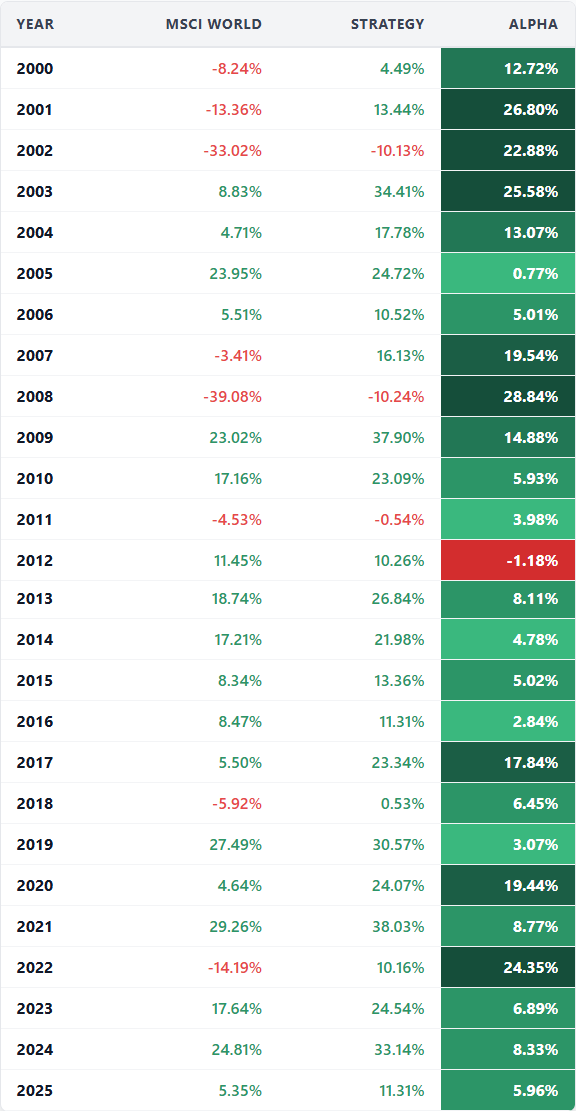
Did I trade this system since 2000? No. So, how can I know the performance 26 years back? I did what’s called a back-test. This means you download historical market data and apply the same systematic trading rules as you would do today.
If anyone had executed the trading rules of my strategy every month, these are the returns they would have achieved (in EUR, not accounting for taxes and trading fees). But how can you know if this outperformance will continue in the future?
Short answer: You can’t. There are no guarantees in investing.
The interesting part: I originally did the back-test in early 2021. Since then, I have traded the strategy with my own money. As you can see from the table, the numbers have continued to look good in real trading.
Don’t worry if you haven’t heard of the MSCI World Index. It’s just a way to measure the returns of the full global stock market (similar to S&P 500 used for measuring the US stock market).
How does it work?
To most people, a trading system sounds complicated. That’s not what this is. My strategy is not a full-time day trading job. I prefer to see it as an alternative to index investing.
A trading system simply implies that buying and selling is decided based on a set of fixed mathematical rules - as opposed to anyone’s opinion or gut feeling.
Trading systems eliminate all the human bias and feelings that tend to make us fail at investing. Instead it focuses on probability and data evidence.
My strategy is a monthly setup. This means, I only have to look at this once every month on the first trading day. The remaining time, I don’t worry about it at all. What happens is the following:
After the last trading day of a month, I download market price data and feed it to the system.
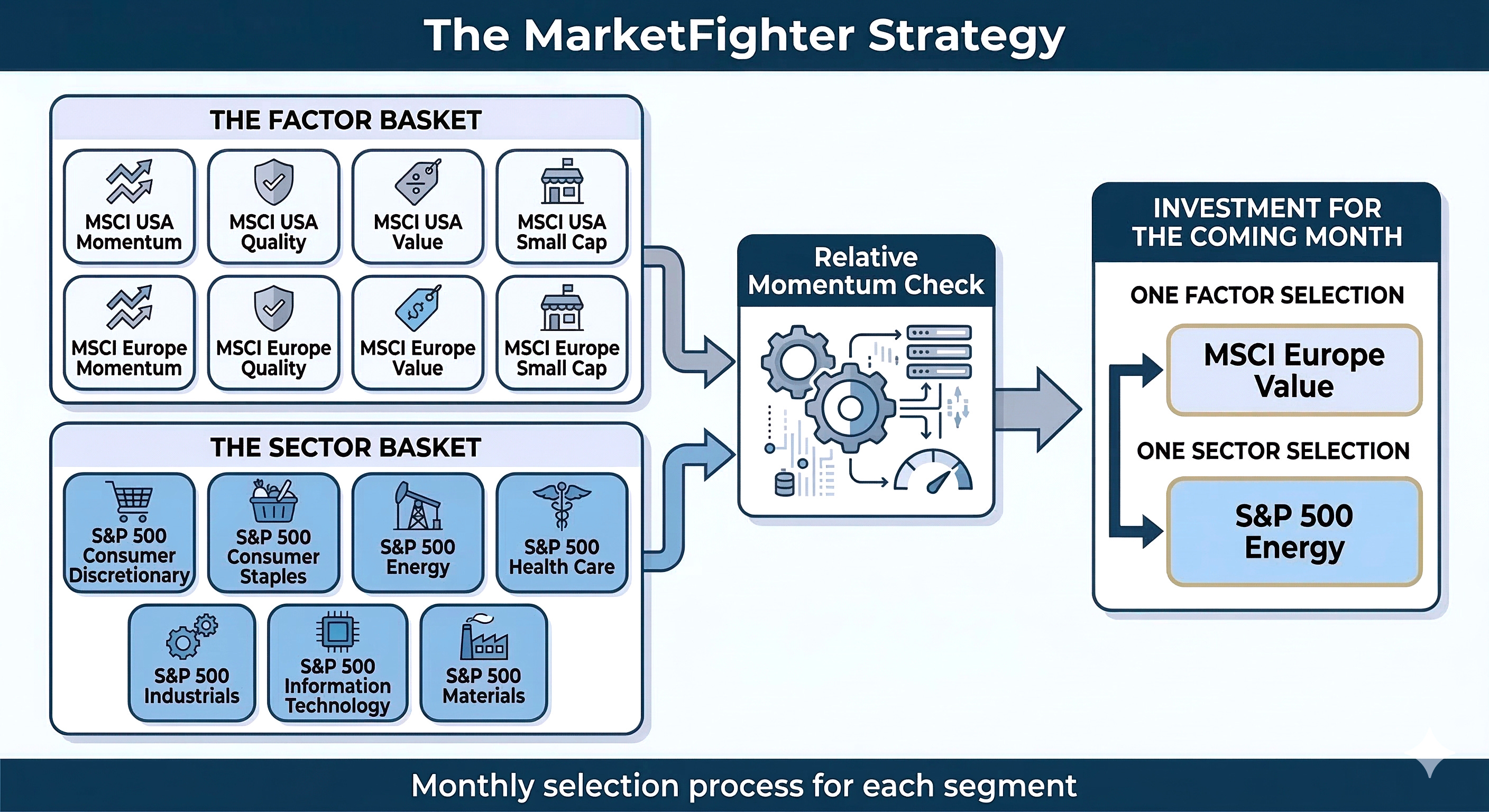
Based on the systematic rules I have entered into the system, it tells me which two ETFs have the highest probability of outperforming in the coming month.
If the two selected ETFs are different from the two from last month, I execute the trades needed on the following day.
Before the market opens on the first trading day of the new month, I send out an email with the new trading signal (provided by the system) to all paid subscribers.
What are these trading rules?
Trading rules are just simple mathematical checks applied to market data. In my case, I built a system that exploits so-called momentum effects in the market. Most of these are well documented in academic literature but not widely used among retail investors.
Simply put, groups of stocks that have done well in the recent past have a higher probability of continuing to do well than other groups.
The system compares certain current and historical price levels among a predefined list of ETFs (or rather indices).
Based on the probability of near-term outperformance (calculated from historical data evidence), it picks the most promising factor and sector ETF. The monthly selection process is illustrated here:
The main concept of my newsletter is to document my strategy, and anyone who’s interested can follow along by simply subscribing to receive the trading signals.
Very often, I receive questions about the details of my algorithm from people who want to copy my strategy and construct the signals themselves. But while my algorithm is proprietary, I publish its output to anyone who’s interested.
If you want to know more about the technical concepts behind the trading rules, I reveal everything except the core details in this article:
➡️ My Investment Approach that Outperformed the Stock Market in 25 of 26 Years
How did I come up with this?
I’ve been active on the stock market for more than 20 years. I’ve been down all the wrong lanes, been a victim of my own fear, greed, and intellectual overconfidence. Made all the classical mistakes.
But my stubborn obsession with outperforming the market has kept me going and I’ve learned from every mistake. Back in early 2021 I finally found a systematic way to achieve higher returns than the indexes through a set of rules.
Since then, I have invested most of our family money using this approach. It has continued to work really well, and recently this gave me the financial flexibility to quit my job as a software engineer. This means I can now focus on my passions for investing, writing and building on my own terms.
Is this too good to be true?
Over the past 26 years, my strategy has delivered an average of roughly 10% above market returns annually. Theoretically, this is considered almost impossible by investment researchers. Most professional funds lag market returns in the long run.
But what I enjoy most about it is the consistency of the returns. It has performed exceptionally well during market crashes historically. The chart below shows how an investment of $100 has evolved with the strategy (yellow) compared to popular market benchmarks:
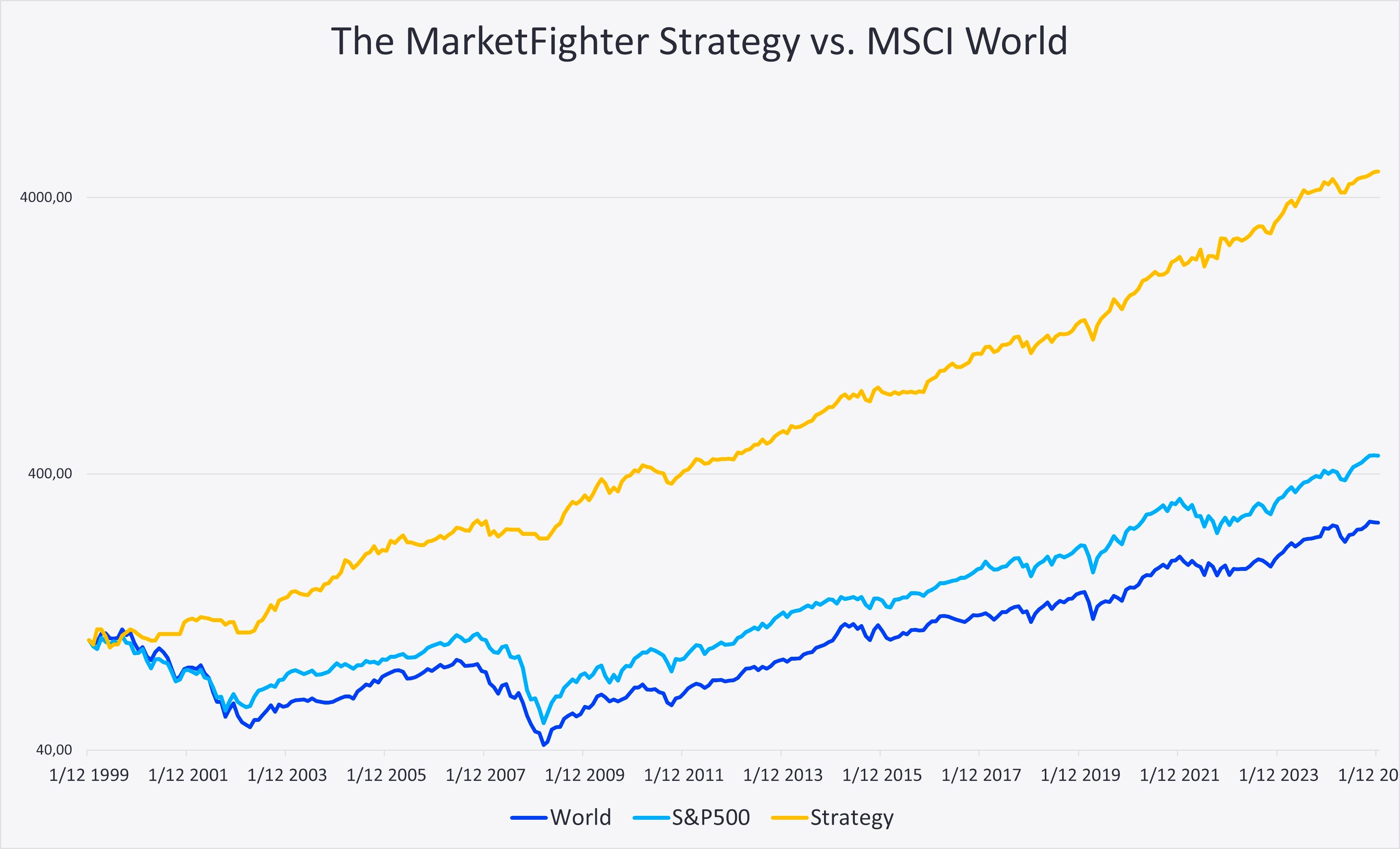
Some people have said my results almost look too good to be true. And honestly, that was also my thought when I initially put together the pieces for the puzzle in early 2021.
That’s why I spent five years quietly trading this strategy without telling anyone, except my nearest family. I was worried that it would stop working after I put money into it. But it has continued, and now, after 5 years it’s running most of my family investments.
What are my expectations for future returns?
The big question is of course whether this can continue. And nothing can ever be guaranteed in investing. No one can predict the future.
My personal guess is that it will continue to outperform, because it’s based on momentum effects which are the results of human psychology that hasn’t changed for centuries.
But my guess is also, that the level of outperformance may not be as high going forward. You should never underestimate the effects of luck and randomness in back-tests, and as more people utilize similar strategies it may affect the level of excess returns. Time will tell.
What’s my recommendation?
It’s important for me to state that I’m not a financial advisor, I have no financial education, and I’m not here to recommend anything.
I’m just a computer scientist who used my skills and was lucky to find my own way to succeed in the markets. Now I’m sharing my journey with anyone who’s curious about my approach.
The strategy I’m following is not a fit for everyone. It requires a lot of discipline to stick to a systematic strategy that sometimes tells you to execute a trade that goes against what you feel in the moment.
In the beginning it was hard for me to do this, but now after more than 5 years, I’ve learned that it pays off to stay disciplined when you’ve found something that works for you. I try to have as little opinion about the market as possible.
For further exploration, check out these other articles:
➡️ Explore the list of ETFs I use for the system
➡️ Find an investment strategy that matches your personality
➡️ Learn what factor investing is and how to use it
➡️ Read the technical deep-dive about the strategy
Now what?
If you’re not part of the journey yet, don’t forget to subscribe. I provide a number of free articles like this one every month.
If you want to receive the monthly trading signals and get full access to the strategy, simply upgrade to the paid subscription to join us. (Psst: You get the best price by doing this through a web browser and not inside the Substack mobile app!)
Thank you for reading!
Disclaimer: The MarketFighter Strategy is for educational and informational purposes only. It is not financial advice, and the author is not a licensed investment advisor. Investing in ETFs involves significant risk, and past performance is never a guarantee of future results. You are solely responsible for your own trades and financial outcomes. Read the full Disclaimer here.
Really enjoyed the article. Funny thing is I see a number of similarities in the approach I’ve developed over the last 7 years (also beating the market since 2019) - but my approach has taken more of a direct indexing angle. I’m planning to publish my first breakdown of the system this Saturday.
What I like most about your system is its simplicity. And if it works? Awesome.
Looking forward to reading more. And if you’re open to checking out mine when it publishes on Saturday, would welcome your thoughts
Will you be adding the equivalent GBP ETFs at anytime? Really interested to subscribe if you do. Thanks