


Hi Friend 👋
Today, I want to share some eye-opening results from recent research that might completely change your approach to active stock-picking.
It goes against the common belief most of us share that stocks in general go up over time. Most of them don’t. In fact, most stocks underperform cash over their full lifetimes, according to new data.
This has a tremendous impact on how we should allocate our money, and investors who position accordingly will stand a much better chance of high returns.
If you own any individual stocks like I do, read on.
New to The MarketFighter Strategy?
I write about a simple approach to beat the stock market with only 15 minutes of monthly work that anyone can copy. Check out these links:
What new research reveals
Let’s start with the facts. If you’ve read any of my previous articles, you will know that I’m a strong believer in research and evidence found in data. My strategy is based on probabilities and facts, not opinions or discretionary analysis.
Earlier this year, Hendrik Bessembinder published a significant study of individual stock returns named One Hundred Years in the U.S. Stock Markets.
The outcome hasn’t received the level of attention I believe it should.
Bessembinder studied the returns of 29,754 individual stocks listed on US exchanges over the past 100 years from 1926 to 2025. These are his main findings:
Bessembinder’s key findings in 2026:
The weighted average stock (“the market”) returned 1,504,057%
The median stock returned -6.9% over its full lifetime
People who owned the market increased their wealth by $91 trillion
People who owned individual stocks lost money on 59% of them
Only 46 companies accounted for half of the entire wealth creation
While these numbers are all eye-opening, none of them are as game-changing as the number I referred to in the title of this article. We’ll get to this shortly.
The findings above confirm that stock returns are heavily skewed. A very small number of stocks account for the wealth creation of what we perceive as the market, while a long tail of individual stocks are left with negative or mediocre returns.
If you’ve come across the name Hendrik Bessembinder before, it’s probably due to the first version of his groundbreaking study, which was published in 2018.
In this first undertaking, he came to all the same conclusions. But what happened since then is that the skewness became even more extreme, concentrating all wealth creation on an even smaller number of companies.
Why stocks are not “the market”
There’s an extremely important point hidden in these data. One that is likely to change how many investors approach the market.
We all know that “the market” has gone up by roughly 10% annually over the past century. But this is only true if we see the market as a market-cap weighted version of the US stock market.
What does market-cap weighted mean? It means you don’t simply measure the average return of all stocks. Instead you weight the stocks by their size (market cap value). Following this approach, Nvidia’s returns account for 6.40% of the total market return, while most stocks account for less than 0.1%.
Under the hood, most market-cap weighted indices like the S&P 500 act as passive momentum engines, letting the winners run and cutting the losers.
The result is an index where performance is heavily carried by a few high-flying names of extraordinary size. Most importantly, it does not represent the performance of a typical stock.
With a few statistical assumptions, we can extract the following annual returns (compound annual growth rates = CAGR) from Bessembinder’s data over the past 100 years of US stock market data:
100 Years of US Stock Returns:
🟢 Weighted average CAGR: 10.1%
🔴 Median stock CAGR: -0.8%
This means, if you had randomly picked a portfolio of individual stocks and sized them equally (not weighted by market cap), you could expect a negative return in the long run!
I was shocked the first time I saw these figures. This single number (the median stock return) might completely change our view on active stock-picking.
To illustrate how the median and the mean (average) can be so different, I created the chart below. My idea was to split all stocks into deciles (groups of 10%) sorted by how much wealth they created for shareholders over a 20-year period.
The actual numbers on the y-axis are just an example to illustrate the concept:
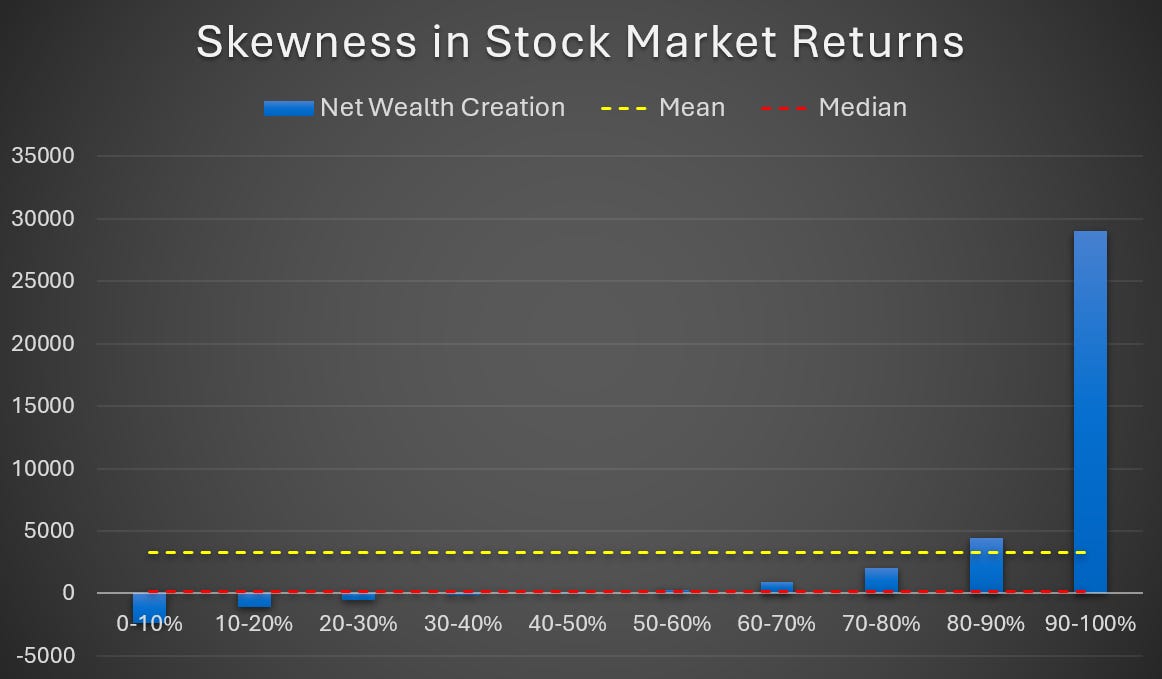
The dashed yellow line illustrates the mean or the market-cap weighted average. This is what’s generally referred to as “market return”.
The dashed red line represents the median. This is the typical stock return you get if you pick randomly, and exactly half of the market is doing better and the other half is doing worse.
Market average returns (the mean) are heavily influenced by a few outliers with extremely high returns. The expected returns from picking stocks randomly (and sizing equally) are closer to the median return, near zero.
The simple math behind this is, of course, that a stock can gain indefinitely on the upside, while it can never lose more than 100%.
Why the average investor underperforms
When faced with cold, hard facts like these, you would expect investors to move away from active stock picking, and many have indeed done so in recent years.
But most of us don’t like to identify ourselves as “average investors”. For many years, I thought I would be able to somehow find my own way of predicting the winners. I guess most of us share similar traits, and this goes a long way to explain why the average investor underperforms so badly:
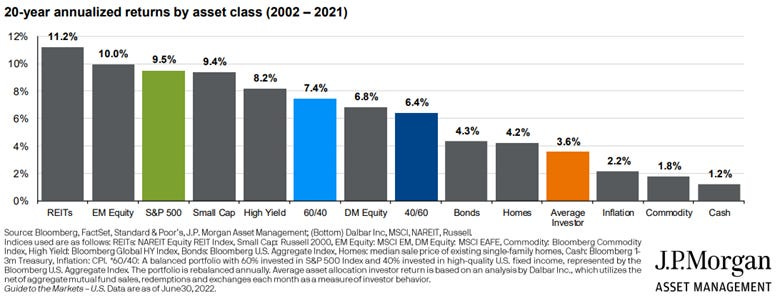
It’s not for fun when the world’s most respected investor Warren Buffett advises his family and everyone around him to simply invest their money in a low-cost S&P 500 index fund.
So, why do we keep picking individual stocks anyway? I believe it comes from a combination of factors:
Entertainment
Owning an index fund often feels like watching paint dry. Following a number of individual stocks is a lot more fun.Overconfidence
It’s a well-documented human bias that we are too confident in our own ability to predict future winners.Lack of knowledge
We expect an average market return, because we’re not aware of the difference between market returns and typical stock returns.
The underperformance of the average investor is not only due to picking individual stocks, but also to bad (biased) timing when entering and leaving positions.
And yes, I acknowledge that there is a small minority of people in this world who, like Warren Buffett in his younger days, can actually pick winner stocks with a significance that almost rules out factors of luck and deceiving randomness. But these are few. Incredibly few, according to data.
Consequences for stock-picking
This leaves the rest of us with a sobering realization. Investing in stocks is often taught as the default way to increase wealth in the long run: Just buy a well-diversified portfolio of stocks and hold them through ups and downs.
This sounds like good advice, because we’ve heard it so many times. But according to Bessembinder’s research, there’s a crucial difference between buying a portfolio of hand-picked stocks and buying a market-cap weighted index fund.
While the index fund has a long term expected return of 10% annually (or 7-8% when adjusting for inflation), the portfolio of hand-picked stocks has an expected return around zero.
This puts us in a special situation as active stock pickers. It forces us to decide:
Will we be good enough at predicting future winners to justify active stock picking instead of holding a market-cap weighted index?
Will we be so good that we can outperform the index (along with 97% of professional fund managers) in the long run?
I know this is a bit provocative. I do own individual stocks myself. But to be completely honest with ourselves and defend this choice, we have to assume we are not only better but significantly better at identifying tomorrow’s winners than the majority of people are, to defy the mathematical odds.
What rational investors do
If you happen to have special skills or a strong belief that you are among the small group of people who can outperform the market with some level of consistency, you can safely skip the remainder of this post ;-)
For the rest of us, there’s nothing wrong with investing actively in individual stocks. The important thing is that we are aware of our odds in the game we’re playing.
Personally, despite my knowledge of the irrationality, I still own a number of individual stocks. I keep these in a small portfolio next to my serious money (all of which are allocated to my ETF strategy). There are a few reasons I still own these stocks:
Entertainment. Many of us like this seemingly intellectual game, although the rational side of me knows better.
Diversification. It gives me a bit of diversification to my ETF strategy.
Taxes. I’ve had them for a long time, and there’s a tax benefit for me in not selling right now.
That being said, if the goal is to optimize wealth in the long run, the rational thing to do for most people will be index investing or systematic investing.
Indexing has a built-in momentum engine that rides the winners and cuts the losers. This approach doesn’t win every single year, but in the long run it beats most other strategies.
Disciplined buy-and-hold indexing can be seen as the simplest form of systematic investing. This is a category of investment strategies aiming to generate higher (or less risky) returns using mathematical rules.
How I switched to a systematic approach
When I first came across the concept of systematic strategies years ago, I was too inexperienced (and frankly, too overconfident) to realize the value of them.
But the more market research I studied, the more I gave in to The Humble Investing Mindset, leading me to accept that I can’t outsmart the market. At least not without a systematic approach.
Index investing works because it eliminates much of the human bias that usually affects active stock-picking. It selects its stocks based on simple mathematical rules, leaving out emotional decisions and overconfidence. It rides the winners that grow big and avoids all the small fish that never succeed.
There are plenty of systematic strategies available, and you can develop your own if you have a scientific mindset, know how to handle data, and don’t mind getting your hands dirty.
Taking advantage of my engineering background, I did this myself, and that’s what most of my newsletter is about. While indexing is the simplest and easiest form to implement, it’s possible to create strategies that generate even higher returns following a systematic approach.
When I accepted that momentum drives market-cap index returns, my next question was: Can you apply systematic momentum rules across broad ETFs with low correlation to achieve even better returns?
Since I started actively trading my own strategy in early 2021, it has outperformed the S&P 500 every year. In backtests it has done so in 22 of the last 26 years.
My system is really just a set of simple mathematical rules based on research findings. It selects two ETFs every month, and I allocate my money into them 50/50. I spend 15 minutes a month on this. The rest of the time, I don’t touch my portfolio.
You can read more about my approach in this article.
The hardest part is maintaining the psychological strength to stay disciplined and stick to an approach like this, when all the noise in the world tells you to do something else. But my results and all the research behind them have given me a solid conviction that keeps me sticking to my strategy.
A reality check on market returns
The common narrative that “stocks go up 10% on average” simply doesn’t apply to individual stocks in general. It applies to market-cap weighted indices like the S&P 500 because of the way it is constructed using systematic momentum-driven rules.
The typical stock has a significantly lower return, with the median stock even generating a negative return over its full lifetime, according to Bessembinder’s latest studies.
Research reveals that our chances of identifying the few winner stocks of tomorrow are so small that we’re better off following a systematic approach. Indexing is the simplest form of systematic investing, but it can act as the gateway to even higher returns for those who dig deeper into systematic strategies.
If you liked this article, I would love to hear your thoughts in the comments. If you’re interested to learn more about my own systematic strategy, and how I managed to outperform the S&P 500 with ETFs, simply subscribe to this newsletter.
Subscribers receive a number of market insight articles like this one for free every month, as well as updates on my systematic approach.
Thank you for reading!
Disclaimer: The MarketFighter Strategy is for educational and informational purposes only. It is not financial advice, and the author is not a licensed investment advisor. Investing in ETFs involves significant risk, and past performance is never a guarantee of future results. You are solely responsible for your own trades and financial outcomes. Read the full Disclaimer here.